
Submit a comment
Abstract
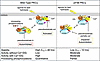
Spinocerebellar ataxia type 14 (SCA14) is an autosomal dominant neurodegenerative disease caused by mutations in the gene encoding protein kinase C γ (PKCγ), a Ca2+- and diacylglycerol-dependent Ser/Thr kinase dominantly expressed in cerebellar Purkinje cells. These mutations impair autoinhibitory constraints to increase the basal activity of the kinase, resulting in deficits in the cerebellum that are not observed upon simple deletion of the gene, and severe ataxia. To better understand the impact of aberrant PKCγ signaling in disease pathology, we developed a knockin murine model of the SCA14 mutation ΔF48 in PKCγ. This fully penetrant mutation is severe in humans and is mechanistically informative, as it has high basal activity but is unresponsive to agonist stimulation. Genetic, behavioral, and molecular testing revealed that ΔF48 PKCγ mice have ataxia-related phenotypes and an altered cerebellar phosphoproteome driven primarily by enhanced Ca2+/calmodulin-dependent kinase 2 signaling, effects that were more severe in male mice. Analysis of existing human data revealed that SCA14 has a significantly earlier age of onset for males compared with females. Data from this clinically relevant mutation suggested that enhanced basal activity of PKCγ is sufficient to cause ataxia and that treatment strategies to modulate aberrant PKCγ may be particularly beneficial in males.
Authors
Sarah A. Wolfe, Yuliang Ma, Tomer M. Yaron-Barir, Carly Chang, Caila A. Pilo, Majid Ghassemian, Amanda J. Roberts, Sang Ryeul Lee, Benjamin A. Henson, Kristen Jepsen, Jared L. Johnson, Lewis C. Cantley, Susan S. Taylor, George Gorrie, Alexandra C. Newton
Guidelines
The Editorial Board will only consider comments that are deemed relevant and of interest to readers. The Journal will not post data that have not been subjected to peer review; or a comment that is essentially a reiteration of another comment.
- Comments appear on the Journal’s website and are linked from the original article’s web page.
- Authors are notified by email if their comments are posted.
- The Journal reserves the right to edit comments for length and clarity.
- No appeals will be considered.
- Comments are not indexed in PubMed.
Specific requirements
- Maximum length, 400 words
- Entered as plain text or HTML
- Author’s name and email address, to be posted with the comment
- Declaration of all potential conflicts of interest (even if these are not ultimately posted); see the Journal’s conflict-of-interest policy
- Comments may not include figures


