
Research ArticleCell biologyNeuroscience
Open Access |  10.1172/jci.insight.198224
Norepinephrinergic projection from locus coeruleus to parafascicular nucleus promotes pain and anxiety-like behaviors in mice
Zhong-Yi Liu,1,2 Fei Li,1 Li-Ming Liu,1,3 Yao-Hua Liu,1,4 Jia Li,1,5 Zi-Ang Li,1,6 Jin Cheng,1,4 Tian-Yu Zhao,1,2 Hui-Min Tian,1,4 Dong-Ning Li,1,4 Sha-Sha Tao,1,5 Hui Li,1 Fen-Sheng Huang,7 and Yun-Qing Li1,3,5
1Department of Anatomy and K.K. Leung Brain Research Centre, The Fourth Military Medical University, Xi’an, China.
2Department of Anatomy, Fujian Medical University, Fuzhou, China.
3Department of Anatomy, School of Medicine, Dali University, Dali, China.
4Department of Anatomy, Baotou Medical College, Inner Mongolia University of Science and Technology, Baotou, China.
5Department of Anatomy, Zunyi Medical University, Zunyi, China.
6Department of Anatomy, School of Medicine, Zhengzhou University, Zhengzhou, China.
7Institute of Neuroscience and Physiology, Göteborg University, Göteborg, Sweden.
Address correspondence to: Yun-Qing Li, Department of Anatomy, Histology, and Embryology, K.K. Leung Brain Research Centre, The Fourth Military Medical University, Changle West Road 169, Xincheng District, Xi’an 710032, China. Email: deptanat@fmmu.edu.cn.
Authorship note: ZYL, FL, and LML contributed equally to this work.
Find articles by Liu, Z. in: PubMed | Google Scholar
1Department of Anatomy and K.K. Leung Brain Research Centre, The Fourth Military Medical University, Xi’an, China.
2Department of Anatomy, Fujian Medical University, Fuzhou, China.
3Department of Anatomy, School of Medicine, Dali University, Dali, China.
4Department of Anatomy, Baotou Medical College, Inner Mongolia University of Science and Technology, Baotou, China.
5Department of Anatomy, Zunyi Medical University, Zunyi, China.
6Department of Anatomy, School of Medicine, Zhengzhou University, Zhengzhou, China.
7Institute of Neuroscience and Physiology, Göteborg University, Göteborg, Sweden.
Address correspondence to: Yun-Qing Li, Department of Anatomy, Histology, and Embryology, K.K. Leung Brain Research Centre, The Fourth Military Medical University, Changle West Road 169, Xincheng District, Xi’an 710032, China. Email: deptanat@fmmu.edu.cn.
Authorship note: ZYL, FL, and LML contributed equally to this work.
Find articles by Li, F. in: PubMed | Google Scholar
1Department of Anatomy and K.K. Leung Brain Research Centre, The Fourth Military Medical University, Xi’an, China.
2Department of Anatomy, Fujian Medical University, Fuzhou, China.
3Department of Anatomy, School of Medicine, Dali University, Dali, China.
4Department of Anatomy, Baotou Medical College, Inner Mongolia University of Science and Technology, Baotou, China.
5Department of Anatomy, Zunyi Medical University, Zunyi, China.
6Department of Anatomy, School of Medicine, Zhengzhou University, Zhengzhou, China.
7Institute of Neuroscience and Physiology, Göteborg University, Göteborg, Sweden.
Address correspondence to: Yun-Qing Li, Department of Anatomy, Histology, and Embryology, K.K. Leung Brain Research Centre, The Fourth Military Medical University, Changle West Road 169, Xincheng District, Xi’an 710032, China. Email: deptanat@fmmu.edu.cn.
Authorship note: ZYL, FL, and LML contributed equally to this work.
Find articles by Liu, L. in: PubMed | Google Scholar
1Department of Anatomy and K.K. Leung Brain Research Centre, The Fourth Military Medical University, Xi’an, China.
2Department of Anatomy, Fujian Medical University, Fuzhou, China.
3Department of Anatomy, School of Medicine, Dali University, Dali, China.
4Department of Anatomy, Baotou Medical College, Inner Mongolia University of Science and Technology, Baotou, China.
5Department of Anatomy, Zunyi Medical University, Zunyi, China.
6Department of Anatomy, School of Medicine, Zhengzhou University, Zhengzhou, China.
7Institute of Neuroscience and Physiology, Göteborg University, Göteborg, Sweden.
Address correspondence to: Yun-Qing Li, Department of Anatomy, Histology, and Embryology, K.K. Leung Brain Research Centre, The Fourth Military Medical University, Changle West Road 169, Xincheng District, Xi’an 710032, China. Email: deptanat@fmmu.edu.cn.
Authorship note: ZYL, FL, and LML contributed equally to this work.
Find articles by Liu, Y. in: PubMed | Google Scholar
1Department of Anatomy and K.K. Leung Brain Research Centre, The Fourth Military Medical University, Xi’an, China.
2Department of Anatomy, Fujian Medical University, Fuzhou, China.
3Department of Anatomy, School of Medicine, Dali University, Dali, China.
4Department of Anatomy, Baotou Medical College, Inner Mongolia University of Science and Technology, Baotou, China.
5Department of Anatomy, Zunyi Medical University, Zunyi, China.
6Department of Anatomy, School of Medicine, Zhengzhou University, Zhengzhou, China.
7Institute of Neuroscience and Physiology, Göteborg University, Göteborg, Sweden.
Address correspondence to: Yun-Qing Li, Department of Anatomy, Histology, and Embryology, K.K. Leung Brain Research Centre, The Fourth Military Medical University, Changle West Road 169, Xincheng District, Xi’an 710032, China. Email: deptanat@fmmu.edu.cn.
Authorship note: ZYL, FL, and LML contributed equally to this work.
Find articles by Li, J. in: PubMed | Google Scholar
1Department of Anatomy and K.K. Leung Brain Research Centre, The Fourth Military Medical University, Xi’an, China.
2Department of Anatomy, Fujian Medical University, Fuzhou, China.
3Department of Anatomy, School of Medicine, Dali University, Dali, China.
4Department of Anatomy, Baotou Medical College, Inner Mongolia University of Science and Technology, Baotou, China.
5Department of Anatomy, Zunyi Medical University, Zunyi, China.
6Department of Anatomy, School of Medicine, Zhengzhou University, Zhengzhou, China.
7Institute of Neuroscience and Physiology, Göteborg University, Göteborg, Sweden.
Address correspondence to: Yun-Qing Li, Department of Anatomy, Histology, and Embryology, K.K. Leung Brain Research Centre, The Fourth Military Medical University, Changle West Road 169, Xincheng District, Xi’an 710032, China. Email: deptanat@fmmu.edu.cn.
Authorship note: ZYL, FL, and LML contributed equally to this work.
Find articles by Li, Z. in: PubMed | Google Scholar
1Department of Anatomy and K.K. Leung Brain Research Centre, The Fourth Military Medical University, Xi’an, China.
2Department of Anatomy, Fujian Medical University, Fuzhou, China.
3Department of Anatomy, School of Medicine, Dali University, Dali, China.
4Department of Anatomy, Baotou Medical College, Inner Mongolia University of Science and Technology, Baotou, China.
5Department of Anatomy, Zunyi Medical University, Zunyi, China.
6Department of Anatomy, School of Medicine, Zhengzhou University, Zhengzhou, China.
7Institute of Neuroscience and Physiology, Göteborg University, Göteborg, Sweden.
Address correspondence to: Yun-Qing Li, Department of Anatomy, Histology, and Embryology, K.K. Leung Brain Research Centre, The Fourth Military Medical University, Changle West Road 169, Xincheng District, Xi’an 710032, China. Email: deptanat@fmmu.edu.cn.
Authorship note: ZYL, FL, and LML contributed equally to this work.
Find articles by Cheng, J. in: PubMed | Google Scholar
1Department of Anatomy and K.K. Leung Brain Research Centre, The Fourth Military Medical University, Xi’an, China.
2Department of Anatomy, Fujian Medical University, Fuzhou, China.
3Department of Anatomy, School of Medicine, Dali University, Dali, China.
4Department of Anatomy, Baotou Medical College, Inner Mongolia University of Science and Technology, Baotou, China.
5Department of Anatomy, Zunyi Medical University, Zunyi, China.
6Department of Anatomy, School of Medicine, Zhengzhou University, Zhengzhou, China.
7Institute of Neuroscience and Physiology, Göteborg University, Göteborg, Sweden.
Address correspondence to: Yun-Qing Li, Department of Anatomy, Histology, and Embryology, K.K. Leung Brain Research Centre, The Fourth Military Medical University, Changle West Road 169, Xincheng District, Xi’an 710032, China. Email: deptanat@fmmu.edu.cn.
Authorship note: ZYL, FL, and LML contributed equally to this work.
Find articles by Zhao, T. in: PubMed | Google Scholar
1Department of Anatomy and K.K. Leung Brain Research Centre, The Fourth Military Medical University, Xi’an, China.
2Department of Anatomy, Fujian Medical University, Fuzhou, China.
3Department of Anatomy, School of Medicine, Dali University, Dali, China.
4Department of Anatomy, Baotou Medical College, Inner Mongolia University of Science and Technology, Baotou, China.
5Department of Anatomy, Zunyi Medical University, Zunyi, China.
6Department of Anatomy, School of Medicine, Zhengzhou University, Zhengzhou, China.
7Institute of Neuroscience and Physiology, Göteborg University, Göteborg, Sweden.
Address correspondence to: Yun-Qing Li, Department of Anatomy, Histology, and Embryology, K.K. Leung Brain Research Centre, The Fourth Military Medical University, Changle West Road 169, Xincheng District, Xi’an 710032, China. Email: deptanat@fmmu.edu.cn.
Authorship note: ZYL, FL, and LML contributed equally to this work.
Find articles by Tian, H. in: PubMed | Google Scholar
1Department of Anatomy and K.K. Leung Brain Research Centre, The Fourth Military Medical University, Xi’an, China.
2Department of Anatomy, Fujian Medical University, Fuzhou, China.
3Department of Anatomy, School of Medicine, Dali University, Dali, China.
4Department of Anatomy, Baotou Medical College, Inner Mongolia University of Science and Technology, Baotou, China.
5Department of Anatomy, Zunyi Medical University, Zunyi, China.
6Department of Anatomy, School of Medicine, Zhengzhou University, Zhengzhou, China.
7Institute of Neuroscience and Physiology, Göteborg University, Göteborg, Sweden.
Address correspondence to: Yun-Qing Li, Department of Anatomy, Histology, and Embryology, K.K. Leung Brain Research Centre, The Fourth Military Medical University, Changle West Road 169, Xincheng District, Xi’an 710032, China. Email: deptanat@fmmu.edu.cn.
Authorship note: ZYL, FL, and LML contributed equally to this work.
Find articles by Li, D. in: PubMed | Google Scholar
1Department of Anatomy and K.K. Leung Brain Research Centre, The Fourth Military Medical University, Xi’an, China.
2Department of Anatomy, Fujian Medical University, Fuzhou, China.
3Department of Anatomy, School of Medicine, Dali University, Dali, China.
4Department of Anatomy, Baotou Medical College, Inner Mongolia University of Science and Technology, Baotou, China.
5Department of Anatomy, Zunyi Medical University, Zunyi, China.
6Department of Anatomy, School of Medicine, Zhengzhou University, Zhengzhou, China.
7Institute of Neuroscience and Physiology, Göteborg University, Göteborg, Sweden.
Address correspondence to: Yun-Qing Li, Department of Anatomy, Histology, and Embryology, K.K. Leung Brain Research Centre, The Fourth Military Medical University, Changle West Road 169, Xincheng District, Xi’an 710032, China. Email: deptanat@fmmu.edu.cn.
Authorship note: ZYL, FL, and LML contributed equally to this work.
Find articles by Tao, S. in: PubMed | Google Scholar
1Department of Anatomy and K.K. Leung Brain Research Centre, The Fourth Military Medical University, Xi’an, China.
2Department of Anatomy, Fujian Medical University, Fuzhou, China.
3Department of Anatomy, School of Medicine, Dali University, Dali, China.
4Department of Anatomy, Baotou Medical College, Inner Mongolia University of Science and Technology, Baotou, China.
5Department of Anatomy, Zunyi Medical University, Zunyi, China.
6Department of Anatomy, School of Medicine, Zhengzhou University, Zhengzhou, China.
7Institute of Neuroscience and Physiology, Göteborg University, Göteborg, Sweden.
Address correspondence to: Yun-Qing Li, Department of Anatomy, Histology, and Embryology, K.K. Leung Brain Research Centre, The Fourth Military Medical University, Changle West Road 169, Xincheng District, Xi’an 710032, China. Email: deptanat@fmmu.edu.cn.
Authorship note: ZYL, FL, and LML contributed equally to this work.
Find articles by
Li, H.
in:
PubMed
|
Google Scholar
|

1Department of Anatomy and K.K. Leung Brain Research Centre, The Fourth Military Medical University, Xi’an, China.
2Department of Anatomy, Fujian Medical University, Fuzhou, China.
3Department of Anatomy, School of Medicine, Dali University, Dali, China.
4Department of Anatomy, Baotou Medical College, Inner Mongolia University of Science and Technology, Baotou, China.
5Department of Anatomy, Zunyi Medical University, Zunyi, China.
6Department of Anatomy, School of Medicine, Zhengzhou University, Zhengzhou, China.
7Institute of Neuroscience and Physiology, Göteborg University, Göteborg, Sweden.
Address correspondence to: Yun-Qing Li, Department of Anatomy, Histology, and Embryology, K.K. Leung Brain Research Centre, The Fourth Military Medical University, Changle West Road 169, Xincheng District, Xi’an 710032, China. Email: deptanat@fmmu.edu.cn.
Authorship note: ZYL, FL, and LML contributed equally to this work.
Find articles by Huang, F. in: PubMed | Google Scholar
1Department of Anatomy and K.K. Leung Brain Research Centre, The Fourth Military Medical University, Xi’an, China.
2Department of Anatomy, Fujian Medical University, Fuzhou, China.
3Department of Anatomy, School of Medicine, Dali University, Dali, China.
4Department of Anatomy, Baotou Medical College, Inner Mongolia University of Science and Technology, Baotou, China.
5Department of Anatomy, Zunyi Medical University, Zunyi, China.
6Department of Anatomy, School of Medicine, Zhengzhou University, Zhengzhou, China.
7Institute of Neuroscience and Physiology, Göteborg University, Göteborg, Sweden.
Address correspondence to: Yun-Qing Li, Department of Anatomy, Histology, and Embryology, K.K. Leung Brain Research Centre, The Fourth Military Medical University, Changle West Road 169, Xincheng District, Xi’an 710032, China. Email: deptanat@fmmu.edu.cn.
Authorship note: ZYL, FL, and LML contributed equally to this work.
Find articles by Li, Y. in: PubMed | Google Scholar
Published April 7, 2026 - More info
JCI Insight. 2026;11(10):e198224. https://doi.org/10.1172/jci.insight.198224.
© 2026 Liu et al. This work is licensed under the Creative Commons Attribution 4.0 International License. To view a copy of this license, visit http://creativecommons.org/licenses/by/4.0/.
Received: July 24, 2025; Accepted: March 31, 2026


-
Results
Activation of CaMKIIα+ neurons in the PF generates analgesic and anxiolytic effects. Previous studies have reported that rodents develop immediate sensory hypersensitivity after nerve injury, followed by anxiety, depression, and cognitive dysfunction within weeks (typically 3–8 weeks, depending on species and animal models) (13, 14). In this study, we assessed the impact of neuropathic pain on pain thresholds and anxiety-like behaviors in mice using the SNI model (Supplemental Figure 1A; supplemental material available online with this article; https://doi.org/10.1172/jci.insight.198224DS1). Mechanical pain thresholds were measured preoperatively and on postoperative days 1, 4, 7, 10, 13, 16, 19, 21, and 28. The results revealed that compared with the Sham group, mice in the SNI group developed mechanical hypersensitivity in both ipsilateral and contralateral sides to the injury on postoperative day 1, with the hind paw withdrawal threshold (PWT) significantly decreased, reaching its nadir on day 4 and persisting through day 28 (Supplemental Figure 1B). In the thermal hyperalgesia test, SNI mice exhibited significant pain sensitization to 52°C and 56°C hot plate stimuli, showing significantly shortened hind paw withdrawal latency (PWL), while no significant differences were detected at 48°C (Supplemental Figure 1C). Anxiety-like behaviors were assessed 5 weeks after surgery. The open field test (OFT) revealed significantly reduced time in center of SNI mice, with no differences in total distance (Supplemental Figure 1, D and E). In the elevated plus maze (EPM), SNI mice exhibited significant decreases in both the number of entries into open arms and the time spent in open arms (Supplemental Figure 1, F and G). These results indicate that neuropathic pain induces persistent pain hypersensitivity and anxiety-like behaviors in mice without affecting locomotor activity.
To investigate whether PF neurons respond to nociceptive stimuli, fiber photometry was used to record Ca2+ activity in PF neurons of mice during von Frey filament and tail pinch stimulation (Figure 1, A and F). Three weeks after viral expression, immunofluorescence histochemistry confirmed extensive colocalization of genetically encoded calcium indicator protein 6 medium (GCaMP6m) and Ca2+/calmodulin–dependent protein kinase IIα (CaMKIIα) in PF neurons (Figure 1, B and G), validating that the recorded Ca2+ signals originated specifically from PFCaMKIIα neurons. Fiber photometry results demonstrated that both von Frey filament and tail pinch stimuli elicited a significant increase in Ca2+-dependent fluorescence intensity (ΔF/F ratio) at an excitation wavelength of 470 nm compared with the reference wavelength of 410 nm in PFCaMKIIα neurons (Figure 1, C–E and H–J). These findings indicate that nociceptive stimuli can activate CaMKIIα+ neurons in the PF.
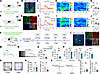 Figure 1
Nociceptive stimuli activate PFCaMKIIα neurons in mice. (A and F) Schematic of von Frey (A) and tail pinch stimulus (F) paradigms using fiber photometry. (B and G) Representative images of viral injection sites (green) in the PF (B) and immunofluorescence colocalization of GCaMP6m+ (green) with CaMKIIα+ neurons (red) (G). (C–E) Ca²+ signal dynamics in PFCaMKIIα neurons during von Frey stimulation: corrected ΔF/F mean values (470 nm vs. 410 nm) (C), heatmaps (D), and quantified area under the curve (AUC) (E). (H–J) Ca²+ signal dynamics in PFCaMKIIα neurons during tail pinch stimulation: ΔF/F mean values (H), heatmaps (I), and quantified AUC (J). (K) Schematic of experimental design. (L) Representative images of viral injection sites (green) in the PF (left) and colocalization of EGFP+ (green) with CaMKIIα+ neurons (red) (right). (M) Schematic of patch-clamp experimental design. (N) Representative current-clamp recordings of hM4Di neurons treated with 10 μM CNO. (O and P) Effects of chemogenetic inhibition of the PFCaMKIIα neurons on mechanical (O) and thermal (P) pain thresholds in naive mice. (R) Total distance (left) and percentage time in center zone (right) during OFT in Control and hM4Di mice. (T) Times of open arm entries (left) and percentage time in open arms (right) during EPM in Control and hM4Di mice. (Q and S) Representative OFT (Q) and EPM (S) movement trajectories for Control and hM4Di mice. Scale bars: 120 μm (B and left panel of L), 20 μm (G), 8 μm (right panel of L). All data are expressed as mean ± SEM (E, n = 14; J, n = 16; O–T, n = 7). Statistical analysis: 2-tailed unpaired t test. *P < 0.05, **P < 0.01, ***P < 0.001. NS, not significant.
To investigate the function of PFCaMKIIα neurons in pain and anxiety-like behaviors in mice, we employed chemogenetic techniques to inhibit these neurons in normal mice (Figure 1K). Electrophysiological recordings revealed membrane hyperpolarization and markedly reduced spontaneous firing rates in hM4Di-expressing neurons following clozapine N-oxide (CNO) administration (Figure 1, M and N), confirming successful viral infection. Immunofluorescence histochemistry revealed colocalization of enhanced green fluorescent protein (EGFP) and CaMKIIα+ neurons in PF (Figure 1L). Behavioral results showed that the hM4Di group exhibited significantly reduced mechanical PWT and thermal PWL (Figure 1, O and P). In the OFT and EPM, the hM4Di group showed no significant differences in total distance or open arm entries compared to the control group, but displayed significantly decreased time spent in the center zone and open arms (Figure 1, Q–T). Conversely, chemogenetic activation of PFCaMKIIα neurons showed no significant modulation of nociceptive thresholds or anxiety-related behaviors, although hM3Dq-expressing neurons exhibited markedly increased spontaneous firing frequencies after CNO administration (Supplemental Figure 2, A–I).
To investigate the role of PFCaMKIIα neurons under pathological conditions, chemogenetic viruses were injected into naive mice, and the SNI model was established subsequently (Figure 2, A and B). Behavioral results demonstrated a significant increase in the mechanical PWT of SNI mice within 7 days postoperatively, although thresholds progressively declined after 7 days (Figure 2C), while thermal hyperalgesia was significantly alleviated on postoperative day 28 (Figure 2D). In the OFT and EPM, the hM3Dq mice showed significant amelioration of anxiety-like behaviors (Figure 2, E–H). Subsequent inhibition of PFCaMKIIα neurons in SNI mice (Supplemental Figure 3A) revealed no significant changes in mechanical/thermal pain thresholds or anxiety-like behaviors (Supplemental Figure 3, B–G). This phenomenon may result from the peak effects of SNI-induced allodynia and anxiety, suggesting that enhanced activity of PFCaMKIIα neurons might be a prerequisite for alleviating pain and anxiety.
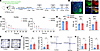 Figure 2
Activation of PFCaMKIIα neurons alleviates pain and anxiety-like behaviors in SNI mice. (A) Schematic of experimental design. (B) Representative images of viral injection sites (green) in the PF (left) and colocalization of EGFP+ (green) with CaMKIIα+ neurons (red) (right). Scale bars: 120 μm (left) and 8 μm (right). (C) PWT (grams) in ipsilateral (right) and contralateral (left) hind paws of Control and hM3Dq mice on postoperative days 0, 1, 4, 7, 10, 13, 16, 19, 21, and 28. (D) PWL (seconds) of Control and hM3Dq mice exposed to 48°C, 52°C, and 56°C hot plates. (E) Representative OFT movement trajectories of Control and hM3Dq mice. (F) Total distance (left) and percentage time in center zone (right) during OFT in Control and hM3Dq mice. (G) Representative EPM movement trajectories of Control and hM3Dq mice. (H) Times of open arm entries (left) and percentage time in open arms (right) during EPM in Control and hM3Dq mice. 3V, third ventricle. All data are expressed as mean ± SEM (n = 7). Statistical analysis: 2-way ANOVA (C); 2-tailed unpaired t test (D, F, and H). *P < 0.05, **P < 0.01, ***P < 0.001. NS, not significant.
The PF receives direct inputs from NEergic neurons of the LC. Based on these findings, we further explored the upstream pain-related brain regions of the PF to identify functional connections integrating pain and anxiety. The retrograde tracer Fluoro-Gold (FG) was injected into the PF (Figure 3, A and B), and dense FG retrograde–labeled (FG+) neurons were observed in the LC (Figure 3C). Immunofluorescence histochemical staining revealed that 92.1% of FG+ neurons colocalized with tyrosine hydroxylase–immunopositive (Th+) neurons in the LC (Figure 3, C and D, and Supplemental Table 1), with 70.1% concentrated in the dorsal region (Supplemental Figure 4 and Supplemental Table 1), suggesting direct projections from LCNE neurons to the PF. To validate this pathway, anterograde tracers were injected into the LC of Th-cre mice (Figure 3, E and F). Virus-labeled fibers and terminals were observed in the PF closely in contact with CaMKIIα+ neurons (Figure 3G), further confirming NEergic neuron projections from the LC to PFCaMKIIα neurons. Retrograde monosynaptic tracing was performed by injecting rabies virus into the PF of Camk2a-cre mice (Figure 3, H–J). Results showed that 76.47% of DsRed+ neurons in the LC colocalized with Th+ neurons (Figure 3, K and L, and Supplemental Table 2). These tracing experiments confirmed that NEergic neurons in the LC project to CaMKIIα+ neurons in the PF. Next, we detected the Fos protein, a neuronal activity marker, in the LC of SNI mice. Results showed a significant increase in Fos+ neurons in the SNI group (182 ± 58.58 vs. 617 ± 41.39; Figure 3, M and N, and Supplemental Table 3), with 69.45% of Fos+ neurons colocalized with Th+ neurons (Figure 3, O and P, and Supplemental Table 4), indicating chronic pain activates LCNE neurons.
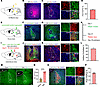 Figure 3
Monosynaptic NEergic projection from the LC to the PFCaMKIIα. (A) Schematic of Fluoro-Gold (FG) injection into the PF. (B) Representative image of FG injection site in the PF. (C) Representative images of FG+ neurons (red, left) colocalization with Th+ neurons (green, right) in the LC. (D) Percentage of FG+ and Th+ double-labeled (FG+Th+) neurons among FG+ neurons in the LC (n = 3). (E) Schematic of anterograde virus injection into the LC. (F) Representative image of viral injection site in the LC. (G) Representative images of EGFP-labeled fibers/terminals (green, left) in close contact with CaMKIIα+ neurons (red) in the PF (right). (H and I) Timeline and schematic for virus injection of retrograde trans-monosynaptic tracing strategy. (J) Representative image of viral injection site in the PF. (K) Representative images of DsRed+ neurons (red, left) colocalization with Th+ neurons (green) in the LC (right). (L) Percentage of DsRed+Th+ neurons among DsRed+ neurons in the LC (n = 3). (M) Representative images of Fos expression in the LC of Sham and SNI mice. (N) The number of Fos+ neurons in the LC of Sham and SNI mice (n = 6). (O) Representative images of Fos+ neurons (green) colocalization with Th+ neurons (red, left), and their high-magnification images (right). (P) Percentage of Fos+Th+ neurons among Fos+ neurons in SNI mice (n = 6). Scale bars: 120 μm (B, F, J, and M and the left panel of C, G, K, and O) and 20 μm (the right panel of C, G, K, and O). 4V, fourth ventricle. All data presented as mean ± SEM. Statistical analysis: 2-tailed unpaired t test (N). ****P < 0.0001.
Activation of the LCNE-PFCaMKIIα neural pathway induces nociceptive hypersensitivity and anxiety-like behaviors in naive mice. To investigate the role of the LCNE-PFCaMKIIα neural pathway in pain and anxiety-like behaviors, we injected chemogenetic activation viruses into the LC and PF of C57BL/6J mice (Figure 4, A–C). Results showed that both PWT and PWL in hM3Dq group mice were significantly decreased (Figure 4, D and E), and anxiety-like behaviors were observed (Figure 4, F–I). Subsequent inhibition of the LCNE-PFCaMKIIα neural pathway (Supplemental Figure 5A) revealed no statistically significant differences in mechanical/thermal pain thresholds or anxiety-like behaviors (Supplemental Figure 5, B–G). These findings suggest that activation of the LCNE-PFCaMKIIα neural pathway under physiological conditions induces nociceptive sensitization and anxiety-like behaviors, while inhibition produces no significant behavioral effects.
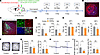 Figure 4
Activation of the LCNE-PFCaMKIIα neural pathway promotes nociceptive hypersensitivity and induces anxiety-like behaviors. (A) Schematic of pathway activation experimental design. (B) Representative image of FG injection sites in the PF. (C) Representative images of EGFP-labeled neurons (green) colocalization with retrograde-labeled neurons (red) from the PF (left), and their high-magnification images (right). (D and E) Effects of chemogenetic activation of the LCNE-PFCaMKIIα neural pathway on mechanical (D) and thermal (E) pain thresholds in naive mice. (F) Representative OFT movement trajectories for Control and hM3Dq mice. (G) Total distance (left) and percentage time in center zone (right) during OFT in Control and hM3Dq mice. (H) Representative EPM movement trajectories for Control and hM3Dq mice. (I) Times of open arm entries (left) and percentage time in open arms (right) during EPM in Control and hM3Dq mice. Scale bars: 120 μm (B and the left panel of C) and 20 μm (the right panel of C). All data presented as mean ± SEM (n = 7). Statistical analysis: 2-tailed unpaired t test (D, E, G, and I). *P < 0.05, **P < 0.01, ***P < 0.001. NS, not significant.
Chemogenetic inhibition of the LCNE-PFCaMKIIα neural pathway alleviates pain and anxiety-like behaviors. Based on the above findings, we hypothesized that the inhibition of CaMKIIα+ neurons in the PF of SNI mice might be driven by NEergic inputs from the LC. To validate this hypothesis, semiquantitative Western blotting analysis of Th protein expression in the LC of Sham and SNI groups mice (postoperative days 7, 21, and 35) revealed progressive upregulation of Th in SNI mice (Figure 5, A–C), confirming sustained NE activation during chronic pain. To investigate the role of the LCNE-PFCaMKIIα neural pathway in chronic pain, chemogenetic inhibition viruses were injected into the LC and PF of mice (Figure 5, D–F). Results demonstrated that hM4Di group mice exhibited significant alleviation of mechanical pain within 7 days after surgery (Figure 5G), although this effect gradually attenuated thereafter. By day 28, a marked improvement in thermal hyperalgesia was observed (Figure 5H), accompanied by concomitant amelioration of anxiety-like behaviors (Figure 5, I–L). Chemogenetic activation experiments (Supplemental Figure 6A) showed no statistically significant differences in pain thresholds or anxiety behaviors (Supplemental Figure 6, B–G), suggesting the pain and anxiety states in mice have reached pathological peak levels. These results indicate that inhibition of the LCNE-PFCaMKIIα neural pathway alleviates chronic pain and anxiety-like behaviors, while activation has no effect.
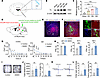 Figure 5
Inhibition of the LCNE-PFCaMKIIα neural pathway alleviates pain and anxiety-like behaviors in SNI mice. (A) Schematic diagram of tissue sampling sites for Western blotting analysis. (B) Representative Western blotting (of 3 independent experiments) showing Th protein levels in the LC at different post-SNI time points. (C) Summarized data of Th protein expression levels. (D) Schematic of pathway inhibition experimental design. (E) Representative image of viral injection sites in the PF. (F) Representative image of EGFP-labeled neurons (green) colocalization with retrograde-labeled neurons (red) from the PF (left), and their high-magnification images (right). (G) PWT (grams) of ipsilateral (right) and contralateral (left) hind paws of Control and hM4Di mice on postoperative days 0, 1, 4, 7, 10, 13, 16, 19, 21, and 28. (H) PWL (seconds) of Control and hM4Di mice exposed to 48°C, 52°C, and 56°C hot plates. (I) Representative OFT movement trajectories. (J) Total distance (left) and percentage time in center zone (right) during OFT in Control and hM4Di mice. (K) Representative EPM movement trajectories. (L) Times of open arm entries (left) and percentage time in open arms (right) during EPM in Control and hM4Di mice. Scale bars: 120 μm (E and the left panel of F) and 20 μm (the right panel of F). All data presented as mean ± SEM (C, n = 3; G, H, J, and K, n = 7). Statistical analysis: 2-way ANOVA (G); 1-way ANOVA (C); or 2-tailed unpaired t test (H, J, and L). *P < 0.05; **P < 0.01; ***P < 0.001; ****P < 0.0001. NS, not significant.
The LC-PF neural pathway mediates pronociceptive and anxiogenic effects via ADRA2 signaling in the PF. The above studies have confirmed that activation of the LCNE-PFCaMKIIα neural pathway promotes both pain and anxiety. To further dissect the mechanism of this pathway, we investigated the distribution and function of ARs in the PF. Based on previous literature (7, 12), to investigate whether ADRA2 in the LC-PF neural pathway plays a critical functional role, we injected anterograde-tracing viruses into the LC of Th-cre mice, followed by multiplex immunofluorescence histochemical staining (Figure 6, A and B). Data revealed colocalization of CaMKIIα+ neurons with ADRA2+ neurons in the PF, and these double-labeled (CaMKIIα+ADRA2+) neurons showed close apposition to anterogradely labeled NEergic fibers/terminals originating from the LC (Figure 6, C and D). Meanwhile, we performed semiquantitative Western blotting analysis of ADRA2 expression in the PF of Sham and SNI mice. Results showed a progressive increase in ADRA2 protein levels in the SNI group during chronic pain progression (Figure 6, E–G), suggesting potential involvement of ADRA2 in pain modulation. These results confirm that LCNE projection activates ADRA2 on PFCaMKIIα neurons.
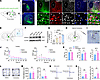 Figure 6
ADRA2 in the PF mediates chronic pain and anxiety. (A) Schematic of anterograde tracing virus injection into the LC. (B) Representative image of viral injection sites in the LC. (C) Representative image of anterograde virus-labeled fibers/terminals in the PF. (D) Representative images of close apposition of CaMKIIα+ neurons (red), ADRA2 (gray), and virus-labeled fibers/terminals (green). White arrows indicate quadruple-labeled neurons (CaMKIIα+ neurons, ADRA2+, virus-labeled fibers/terminals, and DAPI). (E) Schematic diagram of tissue sampling sites for Western blotting analysis. (F) Representative Western blotting (of 3 independent experiments) showing ADRA2 protein levels in the PF at different post-SNI time points. (G) Summarized data of ADRA2 protein expression levels. (H) Schematic of cannula implantation in the PF. (I) Representative image of cannula placement in the PF. (J) PWT (grams) in ipsilateral (right) and contralateral (left) hind paws of saline-treated and yohimbine-treated mice on postoperative days 0, 1, 4, 7, 10, 13, 16, 19, 21, and 28. (K) PWL (seconds) of saline-treated and yohimbine-treated mice exposed to 48°C, 52°C, and 56°C hot plates. (L) Representative OFT movement trajectories. (M) Total distance (left) and percentage time in center zone (right) during OFT in saline-treated and yohimbine-treated mice. (N) Representative EPM movement trajectories. (O) Times of open arm entries (left) and percentage time in open arms (right) during EPM in saline-treated and yohimbine-treated mice. Scale bars: 200 μm (I), 120 μm (B and C), 60 μm (the upper panel of D), and 8 μm (the lower panel of D). All data presented as mean ± SEM (G, n = 3; J–O, n = 7). Statistical analysis: 2-way ANOVA (J); 1-way ANOVA (G); or 2-tailed unpaired t test (K, M, and O). *P < 0.05; **P < 0.01; ***P < 0.001; ****P < 0.0001. NS, not significant.
To investigate the role of ADRA2 in the PF during chronic pain, the ADRA2 antagonist yohimbine was administered via a cannula inserted into the PF of SNI mice and behavioral assessments were conducted (Figure 6, H and I). Results showed that yohimbine had no significant effect on pain thresholds in naive mice, indicating no interference with physiological nociception. However, in SNI mice, yohimbine significantly reversed mechanical allodynia and thermal hyperalgesia (Figure 6, J and K), confirming its analgesic efficacy. In anxiety-related tests, yohimbine-treated mice exhibited increased time spent in the open arms of the EPM compared with saline controls, while no significant differences were observed in total distance or center zone exploration time in the OFT (Figure 6, L–O), suggesting selective alleviation of anxiety-like behaviors.
To elucidate the mechanism, whole-cell patch-clamp recordings of PF neurons in SNI mice (Figure 7, A and B) revealed that ADRA2 blockade increased neuronal firing frequency and enhanced the frequency of spontaneous excitatory postsynaptic currents (sEPSCs), demonstrating that ADRA2 inhibits PF neuron intrinsic excitability to mediate pronociceptive effects (Figure 7, C–I). These findings align with previous reports of ADRA2-mediated presynaptic inhibition (15). Collectively, this study confirmed through pharmacological interventions and electrophysiological evidence that the NEergic projection from the LC to the PF produces pronociceptive effects by activating ADRA2 expressed on CaMKIIα+ neurons within the PF, which subsequently inhibits these CaMKIIα+ neurons.
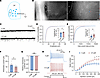 Figure 7
Yohimbine increases the intrinsic excitability of PF neurons. (A) Schematic of whole-cell patch-clamp recordings in PF neurons. (B) Bright-field views of clamped PF neurons. Scale bars: 40 μm (left) and 5 μm (right). (C) Representative sEPSCs (holding potential: –70 mV). (D and E) Amplitude and frequency of sEPSCs: statistics and cumulative curves. (F) Rheobase of PF neurons. (G) Resting membrane potential. (H) Action potential firing (40 ms, 300 pA current step). (I) Spike numbers evoked by depolarizing currents (400 ms, 25 pA increments). All data presented as mean ± SEM (D–I, n = 10 or n = 12). Statistical analysis: 2-way ANOVA (I); 2-tailed unpaired t test (D–G). *P < 0.05. NS, not significant.


