
Oncology
Abstract
Undifferentiated pleomorphic sarcoma (UPS) is one of the most common adult soft tissue sarcomas (STS), yet therapeutic progress remains limited due to the absence of recurrent oncogenic driver mutations. To identify tumor suppressors contributing to UPS pathogenesis, we performed a customized in vivo CRISPR/Cas9 screen in mice. This approach identified BRCA1-associated protein 1 (BAP1) as a potent tumor suppressor in STS. Integrative analyses using RNA sequencing, multiplex immunohistochemistry, and flow cytometry revealed that Bap1-deficient sarcomas exhibited a markedly immunosuppressive tumor microenvironment. Consistent with these findings, BAP1 protein expression was reduced in human UPS, whereas polo-like kinase 1 (PLK1) expression was elevated. Functional studies demonstrated that PLK1 was required for the growth and survival of Bap1-deficient sarcomas. Pharmacologic inhibition of PLK1 with volasertib significantly suppressed tumor growth in both syngeneic and autochthonous mouse models. Moreover, combining PLK1 inhibition with anti-PD-1 therapy enhanced tumor control and improved survival compared with either treatment alone. Together, these results identify PLK1 as a potential therapeutic vulnerability in BAP1-deficient sarcomas and support further evaluation of combined PLK1 inhibition and immune checkpoint blockade as a treatment strategy for a subset of STS.
Authors
Jianguo Huang, Xingliang Liu, Warren Floyd, William Haugh, Zhaoyu Sun, Melissa J. Kasiewicz, Yaping Wu, Brian Piening, John T. Welle, Wesley K. Rosales, Venkatesh Rajamanickam, So Young Kim, Eric S. Xu, Lixia Luo, Yan Ma, Rutulkumar Patel, Ziqiang Zhang, Brady Bernard, William L. Redmond, Walter J. Urba, R. Bryan Bell, David G. Kirsch
Abstract
Selecting appropriate preclinical models is fundamental for translational oncology, yet a large-scale, multi-omic quantitative comparison of their similarity to primary human tumors is lacking. To address this, we integrated transcriptomic, proteomic, and genomic profiles from over 10,000 primary tumors from The Cancer Genome Atlas (TCGA) and the Clinical Proteomic Tumor Analysis Consortium (CPTAC), alongside 4,000 preclinical models. Using a robust computational framework, we revealed a clear hierarchy of transcriptomic and proteomic similarity to patient tumors: patient-derived xenografts (PDXs) > patient-derived organoids (PDOs) = PDX-derived organoids (PDXOs) > cell lines. We also quantified high molecular conservation (Pearson correlation coefficient = 0.96) across paired in vitro to in vivo platform (organoids to PDX) transitions. Furthermore, genomic analysis demonstrated that whole-exome sequencing (WES) outperforms RNA sequencing (RNA-Seq) in detecting DNA variants, and it identified a clonal complexity hierarchy (cell lines > PDXOs > PDXs > PDOs) reflecting the impact of passaging history on intra-tumor heterogeneity. Ultimately, this study delivers a comprehensive quantitative benchmark, establishing a population-level hierarchy of molecular similarity between preclinical models and primary tumors, and providing a data-driven reference for model selection. These findings offer a data-driven framework for selecting models that balance biological representativeness with experimental practicality.
Authors
Zixuan Xie, Jia Xue, Binchen Mao, Hengyuan Liu, Wubin Qian, Jingjing Wang, Xiaobo Chen, Sheng Guo

Abstract
Authors
Erin M. Dickey, Harper M. Marsh, Camilla Rydberg-Millrud, Haleh Amirian, Karthik Rajkumar, Manan Patel, Andrew Adams, Anuroop Allena, Kevin Van der Jeught, Nipun Merchant, Peter J. Hosein, Anna Bianchi, David Liberg, Jashodeep Datta
Abstract
While Wilms tumors commonly arise from renal precursor cells and maintain features of the developing kidney, recent studies have demonstrated significant genetic, histologic, and molecular heterogeneity. To further investigate tumor variability as well as unifying features in tumor biology, we performed single nuclei RNA-sequencing (snRNA-seq) on treatment naïve, favorable histology Wilms tumors utilizing a reference atlas established from tumor-adjacent kidney samples and fetal kidney. Transcriptional profiles of blastemal, stromal, and epithelial components were correlated with tumor histology and demonstrate developmental-lineage plasticity, with PAX2 and PAX8 expression normally restricted to the nephron lineage of the fetal kidney found to be expressed in tumor stroma, as well as the stromal marker POSTN identified in tumor blastema. Further analyses of the blastema show shared transcriptional features with the differentiation trajectory of “uninduced” to “early differentiating” fetal nephron progenitor cells as well as aberrant expression of stromal signatures. A number of pathways from fetal nephron progenitors were maintained in the blastema, including regulation of stem cell maintainence and axonogenesis, whereas other pathways appear enriched in specific tumor samples, demonstrating the ability of snRNA-seq to identify both unifiying transcriptional signatures and uncover distinct molecular targets in signaling pathways and/or biological drivers of Wilms tumorigenesis.
Authors
Mike Adam, Keri A. Drake, Naomi Pode-Shakked, Katherine VandenHeuvel, Steve Potter, James Geller
Abstract
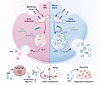
Tumor cells are constantly confronted with nutrient deprivation; however, the effect of serum starvation on the remodeling of endosomal compartments and extracellular vesicles (EVs) in tumor cells remains unclear. Here, we found that serum starvation pronouncedly promotes multivesicular body (MVB) biogenesis, EV formation, and cargo selection. Specifically, by generating a constitutively active Rab5Q79L mutant to induce the enlargement of MVB, we revealed for the first time to our knowledge that ANXA3 is sorted into intraluminal vesicles (ILVs) of MVB. Mechanistically, we confirmed that serum starvation regulates the endosomal sorting complex required for transport–associated (ESCRT-associated) protein ALG-2 interacting protein X (ALIX), which recruits ESCRT-III to MVB and binds to annexin A3 (ANXA3) to mediate its sorting into ILVs of MVB. Our study highlights that serum starvation promotes an ALIX-dependent ESCRT-III recruitment pathway, which loads protumor ANXA3 cargo to exert a profound effect on tumor progression.
Authors
Xueqiang Peng, Jiaxing Liu, Guolong Zeng, Yafei Xiao, Zhixiong Hao, Guangpeng He, Hongyuan Jin, Yu Gao, Shilei Tang, Shibo Wei, Yan Li, Yifan Yu, Liang Yang, Hangyu Li
Abstract
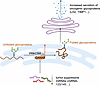
Non-small cell lung cancer (NSCLC) remains a leading cause of cancer-related mortality worldwide, yet its molecular drivers are not fully defined. Emerging evidence highlights the importance of tumor-stroma interactions mediated by secreted glycoproteins. However, the mechanisms by which cancer cells regulate the secretion of these protumorigenic proteins remain largely unknown. Endoplasmic reticulum–resident (ER-resident) N-glycan–processing enzymes regulate proper protein folding, a prerequisite for glycoproteins to exit the ER and undergo secretion. By evaluating their prognostic significance in lung tumors and conducting functional screening in lung cancer cells, we identify α-glucosidase II (α-Glc II) as a key regulator of NSCLC progression. α-Glc II promotes tumor growth and dissemination in a glucosidase activity–dependent manner in orthotopic mouse lung tumor model. Genetic disruption of α-Glc II induced ER stress and reduced cell proliferation and motility. Mechanistically, α-Glc II–mediated N-glycan modification regulated the ER-to-Golgi trafficking and secretion of specific oncogenic glycoproteins, including lysyl hydroxylase 2 (LH2), Tissue Inhibitor of Metalloproteinase 1 (TIMP1), and TGF-β, which are known to be associated with extracellular matrix remodeling. These findings uncover a role for ER glycosylation machinery in shaping the NSCLC secretome and highlight α-Glc II as a potential therapeutic target.
Authors
Shike Wang, Na Ding, Angelo Chen, Derrick Cardin, Yuting Xu, Kate Grimley, William K. Russell, Jun Xu, Jonathan M. Kurie, Guan-Yu Xiao, Xiaochao Tan
Abstract
Tuberous sclerosis complex (TSC) and Lymphangioleiomyomatosis (LAM) lack well-defined cellular origins, limiting treatment options. In this report, scRNA-seq of Tsc2+/− mouse renal cystadenomas revealed an 80-fold increase in a tumor cell subpopulation with neural crest features, and expressing known cranial neural crest genes as SRY box transcription factor 9 (Sox9), transcription factor activator protein (Tfap2a), and candidate neurocristopathy markers, osteopontin (Spp1), lipocalin-2 (Lcn2), clusterin (Clu), and cytokeratin 18 (Krt18). These signatures were validated in mouse tumors, and LAM patient lesions and serum, identifying a tumor phenotype distinct from traditional VEGFD detection. Pathway analysis indicated activation of WNT/SHH signaling, nephric duct formation, and pro-tumorigenic signals, with transcription factor 7 (Tcf7) and ephrin-A ligands as key upstream regulators. Spp1 KO in cranial neural crest cells (CNCCs) significantly reduced proliferation (28–33%), migration (54-76%), and invasion (29-64%) without affecting viability, while Tsc2 KO increased viability 3 to 6-fold with minimal impact on chemotaxis. Elevated serum levels of SPP1 and KRT18 in some LAM patients, decreased LCN2 in nearly all, and distinct increases in VEGFD suggest complementary roles for these biomarkers. Overall, findings support a neurocristopathic model of tumor development in TSC and LAM and identify potential biomarkers and therapeutic targets beyond mTOR inhibition.
Authors
Uchenna J. Unachukwu, Enio B. Garcia, Nooralam Rai, Jeanine M. D'Armiento
Abstract
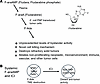
We investigated whether destroying malignant cells and the associated tumor microenvironment (TME) by focal gene therapy would broaden immune checkpoint inhibitor (ICI) effectiveness. We show that ICI antitumor activity against syngeneic (murine) triple-negative breast cancer (TNBC) was augmented when a therapeutic transgene (purine nucleoside phosphorylase, referred to here as E. coli PNP) was used to cleave fludarabine (2-fluoro-arabinofuranosyl adenine) to the anticancer purine base, 2-fluoroadenine (F-Ade). We also established strong repression of anatomically distant, non-PNP-expressing tumors being treated by the same strategy. TNBC cytoreduction was associated with decreased intratumoral PD1+ Tregs, increased granzyme B+ NK cells, elevated MKI67+ T8 cells, and rapid immune clearance. Because F-Ade works by a mechanism that destroys quiescent neoplastic and supporting cells in the microenvironment, and since resistance to ICIs depends upon an intact TME, tumor killing by this approach offers a means to sensitize refractory malignancies to immune ablation and points to broad applicability against numerous cancer subtypes.
Authors
Regina Rab, Jeong S. Hong, Brendan L.C. Kinney, Nicole C. Schmitt, William B. Parker, Adrianna Westbrook, Kelsey B. Bennion, Mandy L. Ford, Douglas H. Weitzel, Paula L. Miliani de Marval, Eric J. Sorscher, Annette Ehrhardt

Abstract
Brain metastases (BrMs) occur in approximately 30% of cancer patients, causing nearly one-fifth of cancer deaths. While immune checkpoint inhibitors (ICIs) benefit some BrM patients, responses remain highly variable. This variability partly reflects distinct histopathological growth patterns that include minimally invasive (MI) and highly invasive (HI) brain BrMs. Here we show that MI BrMs exhibit robust immune infiltration, whereas HI lesions are immunosuppressed. However, histological differentiation between MI and HI can be challenging because of subjective margin assessment. Here, using highly multiplexed spatial proteomics on 119 tumor sections from 46 patients with BrMs, we identify CHI3L1 as a key mediator of the immunosuppressive microenvironment in HI BrMs. In preclinical models, genetic deletion of CHI3L1 converts immune-cold metastases into lymphocyte-rich, ICI-responsive lesions infiltrated by granzyme B+ CD8+ T cells. In BrM patients treated with ICI, immunohistochemical quantification of CHI3L1 expression was a stronger predictor of ICI response than traditional MI/HI classification. Thus, CHI3L1 represents a promising biomarker and therapeutic target for BrMs.
Authors
Sarah M. Maritan, Elham Karimi, Matthew Dankner, Aldo Hernandez-Corchado, Miranda W. Yu, Matthew G. Annis, Yashar Aghazadeh Habashi, Morteza Rezanejad, Bridget Liu, Nebras Koudieh, Emilie Pichette, Parvaneh Fallah, Benoit Fiset, Yuhong Wei, Ali Nehme, Chun Geun Lee, Jack A. Elias, Morag Park, Yasser Riazalhosseini, Hamed Najafabadi, Kevin Petrecca, Marie-Christine Guiot, Daniela F. Quail, Logan A. Walsh, Peter M. Siegel

Abstract
Bladder cancer (BCa) mortality is mainly driven by metastatic dissemination and an immunosuppressive tumor microenvironment. Here, we identify ELN (tropoelastin), an extracellular matrix protein abundantly secreted by cancer-associated fibroblasts (CAFs), as a critical determinant of these processes and a marker of poor prognosis. ELN promotes epithelial-mesenchymal transition (EMT), facilitates lymphatic spread, and induces immune dysfunction characterized by macrophage polarization toward an M2 phenotype and T cell exhaustion. Mechanistically, ELN functions as a binding partner of TGF-β receptor 2 (TGFBR2), thereby triggering SMAD2/3-dependent TGF-β1 secretion and establishing a feed forward signaling loop. This ELN/TGFBR2/TGF-β1 axis amplifies metastatic capacity and immunosuppressive signaling, ultimately accelerating disease progression and diminishing responsiveness to immune checkpoint blockade. Functional studies in BCa organoids and murine models demonstrated that pharmacologic blockade of the ELN-TGFBR2 interaction effectively suppressed tumor metastasis and restored antitumor immunity. Collectively, our findings establish ELN as a CAF-derived driver of metastasis and immune evasion in BCa. Targeting the ELN-TGFBR2 interaction offers a promising therapeutic strategy to limit metastatic progression and enhance the efficacy of immunotherapy in this lethal disease.
Authors
Wentao Xu, Jia Gao, Shanshan Wu, Jianshang Huang, Chenchen An, Chonggui Jiang, Nianping Liu, Chen Cheng, Zihan Wang, Zijian Dong, Yuchen Xu, Jun Zhou, Hanren Dai, Xiaolei Li, Honghai Xu, Songyun Zhao, Qianwen Fan, Yang Li, Ying Dai, Li Zuo, Hua Wang
No posts were found with this tag.


