
Microbiology
Abstract
Autophagy is a critical host defense mechanism that restricts intracellular pathogens such as Mycobacterium tuberculosis (Mtb). A key step in this process is the ubiquitination of Mtb or Mtb-associated structures. The E3 ligase SMURF1 catalyzes K48-linked ubiquitination, promoting bacterial clearance. However, the function of its homolog, SMURF2, in host defense remains undefined. Here, we demonstrate that Smurf2 deletion in murine macrophages increases SMURF1 levels, enhances LC3B lipidation, augments K48 ubiquitination of Mtb-associated structures, and reduces intracellular Mtb replication. These effects are reversed by Smurf1 deletion, supporting a role for SMURF1 in SMURF2-dependent control of Mtb. Mice with myeloid-specific Smurf2 deletion exhibit modestly prolonged survival following aerosol Mtb infection. In human macrophages, SMURF2 knockdown or its pharmacological inhibition with the HECT E3-ligase inhibitor Heclin reduces Mtb replication. Together, our findings identify SMURF2 as a negative regulator of macrophage control of Mtb and support further investigation of SMURF2 as a potential target for host-directed therapy in tuberculosis.
Authors
Priscila C. Campos, Kathryn C. Rahlwes, Victoria A. Ektnitphong, Beatriz R.S. Dias, Kubra F. Naqvi, Samuel Alvarez-Arguedas, Michael U. Shiloh
Abstract
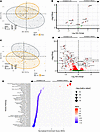
Serious non-AIDS events (SNAEs), including non-AIDS malignancies, cardiovascular disease, and hepatic complications, remain major causes of mortality in treated HIV infection. These outcomes are driven by persistent immune activation, systemic inflammation, and metabolic dysfunction despite effective viral suppression with antiretroviral therapy (ART). To investigate mechanisms underlying SNAE pathogenesis, we performed a cross-site multi-omic analysis integrating plasma proteins, plasma metabolites, and mucosal microbiomes in 82 ART-treated people with HIV (PWH) and 10 people without HIV from the United States and Mexico. Geography was the dominant source of variation, particularly across lipid classes. However, individuals at high risk for SNAEs, defined by low CD4+ T cell counts and low CD4/CD8 ratios, shared a consistent signature of systemic inflammation, mitochondrial dysfunction, and microbial dysbiosis, including elevated plasma IL-6 and ω-oxidation products (adipic and suberic acids) and depletion of short-chain fatty acid–producing commensals in the gut mucosa, including Akkermansia muciniphila, Bacteroides uniformis, and Ruminococcus. A. muciniphila abundance correlated with lower IL-6 levels, fewer HIV RNA-producing cells in lymph nodes, and higher CD4/CD8 ratios. These findings identify a shared inflammatory and metabolic phenotype in PWH and implicate A. muciniphila as a potential microbiome-based target to mitigate immune activation and SNAE risk in treated HIV.
Authors
Christopher M. Basting, Jodi Anderson, Kevin Escandón, Garritt Wieking, Candace Guerrero, Jarrett Reichel, Ross T. Cromarty, Erik Swanson, Ty Schroeder, Elaina Creagan, Maura Barrett, Fernanda Torres-Ruiz, Maribel Soto-Nava, Lady Carvajal-Ruiz, Karla Krystel Ordaz-Candelario, Olivia Briceño, Nicholas Funderburg, Melanie Graham, Peter Hunt, Santiago Avila-Rios, Gonzalo Salgado Montes de Oca, Timothy W. Schacker, Nichole R. Klatt
Abstract
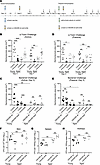
Postnatal growth faltering is a pervasive problem among extremely preterm infants that is independently associated with adverse neurodevelopmental outcomes. We previously observed that preterm infants with poor postnatal growth have altered development of the intestinal microbiota relative to preterm infants with appropriate postnatal growth. Here, we used gnotobiotic mice to investigate whether these differences in microbiota development independently contribute to growth faltering. We found that colonization of neonatal mice with microbiotas from extremely preterm infants with poor growth reproduced postnatal growth impairment and induced a metabolic signature of enhanced lipolysis and fatty acid oxidation in the mice, characterized by elevated hepatic acylcarnitines and circulating ketones. In mice colonized at birth with microbiotas from infants with poor growth, postnatal treatment with microbiotas from infants with appropriate growth prevented growth impairment. These results indicate that altered development of the intestinal microbiota contributes to growth faltering in extremely preterm infants, and that microbiota modification can restore postnatal growth.
Authors
Kwai Tei Chan Poon, Se Hyang Han, Olga Ilkayeva, Michael J. Muehlbauer, Christopher B. Newgard, Charles M. Cotten, Patricia L. Ashley, Patrick C. Seed, John F. Rawls, Noelle E. Younge
Abstract
It remains unclear why vaccines targeting prominent microbial virulence factors often fail in clinical trials. Because microbial virulence depends on interaction with the host immune system, we investigated how changes in host immune function alter vaccine efficacy. Using a vaccine against Staphylococcus aureus α-toxin (Hla), which targets host metalloprotease ADAM10 on myeloid cells, we show that Hla virulence is reduced in aged mice due to diminished ADAM10 activity and impaired myeloid cell function. Depletion of myeloid cells with cyclophosphamide in young mice similarly reduced toxin virulence. Immunization against Hla conferred strong protection against S. aureus infection in young but not aged mice. These findings indicate that pathogenic functions of microbial factors characterized in immunocompetent young animals may not predict virulence or vaccine efficacy in immunocompromised hosts. These findings underscore the need to account for host immune status in the development and evaluation of vaccines targeting microbial virulence factors.
Authors
Xin Du, Ching Wen Tseng, Elisabet Bjånes, Hunter Gage, Jaclyn Swan, Chih-Ming Tsai, Irshad A. Hajam, Cesia Gonzalez, Brian Lin, Victor Nizet, George Y. Liu
Abstract
BACKGROUND. Malaria caused by Plasmodium malariae is geographically widespread and sometimes associated with prolonged infection, yet little is known about its genomic epidemiology. METHODS. We performed hybrid capture and whole genome sequencing of 77 isolates collected from Cameroon (n=7), the Democratic Republic of the Congo (n=16), Nigeria (n=4), and Tanzania (n=50) between 2015 and 2021, and analyzing parasite genetic population structure and demography. RESULTS. There is no evidence of geographic population structure. Nucleotide diversity was significantly lower than in co-localized P. falciparum isolates, while linkage disequilibrium was significantly higher. Genome-wide selection scans identified no erythrocyte invasion ligands or antimalarial resistance orthologs as top hits; however, targeted analyses of these loci revealed evidence of selective sweeps around four erythrocyte invasion ligands and six antimalarial resistance orthologs. Demographic inference modeling suggests that African P. malariae is recovering from a bottleneck. CONCLUSION.P. malariae is genomically atypical among human Plasmodium spp. and lacks strong population structure in Africa. The low diversity has potential impacts on understanding persistent versus new infection through genomic epidemiology.
Authors
Zachary R. Popkin-Hall, Kelly Carey-Ewend, Farhang Aghakhanian, Eniyou C. Oriero, Misago D. Seth, Melchior M. Kashamuka, Billy Ngasala, Innocent M. Ali, Eric Mukomena SOMPWE, Celine I. Mandara, Oksana Kharabora, Rachel Sendor, Alfred Simkin, Alfred Amambua-Ngwa, Antoinette Tshefu, Abebe A. Fola, Deus S. Ishengoma, Jeffrey A. Bailey, Jonathan B. Parr, Jessica T. Lin, Jonathan J. Juliano
In Vivo Characterization of Candida Extracellular Vesicles Reveals Unique Infection Pathway Proteins
Abstract
Authors
Justin Massey, Robert Zarnowski, William Hartman Jr., Jeniel E. Nett, David R. Andes
Abstract
CD4 T cells are essential for immunity to M. tuberculosis (Mtb), and emerging evidence indicates that IL-17-producing Th17 cells contribute to immunity to Mtb. While identifying protective T cell effector functions is important for TB vaccine design, T cell antigen specificity is also likely to be important. To identify antigens that induce protective immunity, we reasoned that, as in other pathogens, effective immune recognition drives sequence diversity in individual Mtb antigens. We previously identified Mtb genes under evolutionary diversifying selection pressure whose products we term Rare Variable Mtb Antigens (RVMA). Here, in two distinct human cohorts with recent exposure to TB, we found that RVMA preferentially induce CD4 T cells that express RoRγt and produce IL-17, in contrast to ‘classical’ Mtb antigens that induce T cells that produce IFNγ. Together with emerging evidence showing human Th17 responses are associated with prevention of progression to TB disease, our results suggest that RVMA can be valuable antigens in vaccines for those already infected with Mtb to amplify existing antigen-specific Th17 responses to prevent TB disease.
Authors
Paul Ogongo, Liya Wassie, Anthony Tran, Devin Columbus, Julia Huffaker, Lisa Sharling, Gregory Ouma, Samuel Gurrion Ouma, Kidist Bobosha, Cecilia S. Lindestam Arlehamn, Neel R. Gandhi, Sara C. Auld, Jyothi Rengarajan, Cheryl L. Day, Artur Queiroz, Mariana Araújo-Pereira, Eduardo Fukutani, Bruno B. Andrade, John D. Altman, Henry M. Blumberg, Joel D. Ernst

Abstract
Sepsis is a life-threatening organ dysfunction caused by a dysregulated host response to infection. During early sepsis, kinins are released and bind to B1 (BDKRB1) and B2 (BDKRB2) bradykinin receptors, but the involvement of these receptors in sepsis remains incompletely understood. This study demonstrated that the genetic deletion of Bdkrb2 had no significant impact on sepsis induced by cecal ligation and puncture (CLP) compared to wild-type (WT) mice. In contrast, Bdkrb1−/− mice subjected to CLP exhibited decreased lethality and bacterial load, associated with an increased influx of neutrophils into the peritoneal cavity, compared with WT mice. Neutrophils from CLP-Bdkrb1−/− mice partially restored CXCR2 expression and reduced the upregulation of P110γ observed in WT CLP neutrophils. Pharmacologic inhibition of BDKRB1 combined with imipenem treatment substantially improved survival compared with antibiotic therapy alone. In human neutrophils, stimulation with LPS led to the upregulation of BDKRB1 expression, and antagonism of BDKRB1 restored neutrophil migration in response to CXCL8. These findings identify BDKRB1 as an important modulator of neutrophil dysfunction in sepsis and a promising therapeutic target whose inhibition improves bacterial clearance, restores neutrophil migration, and increases the efficacy of antibiotic treatment.
Authors
Raquel Duque do Nascimento Arifa, Carolina Braga Resende Mascarenhas, Lívia Caroline Resende Rossi, Maria Eduarda Freitas Silva, Larissa M. Lucas, João Paulo Pezzini Barbosa, Daiane Boff, Brenda Gonçalves Resende, Lívia Duarte Tavares, Alesandra Corte Reis, Vanessa Pinho, Flavio Almeida Amaral, Caio Tavares Fagundes, Cristiano Xavier Lima, Mauro Martins Teixeira, Daniele G Souza
Abstract
Empirical data from survivors of Lassa fever and experimental disease modelling efforts, particularly those using mouse models, are at odds with respect to T cell-mediated pathogenesis. In mice, T cells have been shown to be imperative in disease progression and lethality, whereas in humans, an early and robust T cell responses has been associated with survival. Here, we assessed the role of CD4+ and CD8+ T cells on disease progression and severity of Lassa virus infection in a non-human primate model. Using an antibody-mediated T cell depletion strategy prior to and post-inoculation, we were able to examine Lassa virus infection in the absence of specific T cell responses. In animals depleted for either CD4+ or CD8+ T cells, Lassa virus infection remained uniformly lethal, with only a slight delay in disease progression observed in the CD4-depleted group when compared to non-depleted controls. Milder pulmonary pathology was noticed in the absence of CD4+ or CD8+ T cells. Overall, our findings suggest that T cells have a limited impact on the development of Lassa fever in non-human primates.
Authors
Jérémie Prévost, Nikesh Tailor, Geoff Soule, Jonathan Audet, Yvon Deschambault, Robert Vendramelli, Jessica Prado-Smith, Kevin Tierney, Kimberly Azaransky, Darwyn Kobasa, Chad S. Clancy, Heinz Feldmann, Kyle Rosenke, David Safronetz
Abstract
To radically diminish TB incidence and mortality by 2035, as set out by the WHO End TB Strategy, there is a desperate need for improved TB therapies and a more effective vaccine against the deadly pathogen Mycobacterium tuberculosis (Mtb). Aerosol vaccination with the MtbΔsigH mutant protects two different species of NHPs against lethal TB challenge by invoking vastly superior T and B cell responses in the lungs through superior antigen-presentation and interferon-conditioning. Since the Geneva consensus on essential steps towards the development of live mycobacterial vaccines recommends that live TB vaccines must incorporate at least two independent gene knock outs, we have now generated several rationally designed, double (DKO)- and triple (TKO) knock-out mutants in Mtb, each containing the ΔsigH deletion. Here, we report preclinical studies in the rhesus macaque model of aerosol infection and SIV/HIV co-infection, aimed at assessing the safety of these MtbΔsigH - based DKOs and TKOs. We found that most of these mutant strains are attenuated in both immunocompetent and SIV-co-infected macaques and combinatorial infection with these generated strong cellular immune responses in the lung, akin to MtbΔsigH. Aerosol infection with these KO strains elicited inducible Bronchus Associated Lymphoid Tissue (iBALT), which is a correlate of protection from TB.
Authors
Garima Arora, Caden W. Munson, Mushtaq Ahmed, Vinay Shivanna, Annu Devi, Venkata S.R. Devireddy, Basil Antony, Shannan Hall-Ursone, Olga D. Gonzalez, Edward Dick Jr., Chinnaswamy Jagannath, Xavier Alvarez, Smriti Mehra, Shabaana A. Khader, Dhiraj K. Singh, Deepak Kaushal
No posts were found with this tag.


