
Abstract
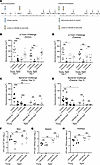
It remains unclear why vaccines targeting prominent microbial virulence factors often fail in clinical trials. Because microbial virulence depends on interaction with the host immune system, we investigated how changes in host immune function alter vaccine efficacy. Using a vaccine against Staphylococcus aureus α-toxin (Hla), which targets host metalloprotease ADAM10 on myeloid cells, we show that Hla virulence is reduced in aged mice due to diminished ADAM10 activity and impaired myeloid cell function. Depletion of myeloid cells with cyclophosphamide in young mice similarly reduced toxin virulence. Immunization against Hla conferred strong protection against S. aureus infection in young but not aged mice. These findings indicate that pathogenic functions of microbial factors characterized in immunocompetent young animals may not predict virulence or vaccine efficacy in immunocompromised hosts. These findings underscore the need to account for host immune status in the development and evaluation of vaccines targeting microbial virulence factors.
Authors
Xin Du, Ching Wen Tseng, Elisabet Bjånes, Hunter Gage, Jaclyn Swan, Chih-Ming Tsai, Irshad A. Hajam, Cesia Gonzalez, Brian Lin, Victor Nizet, George Y. Liu
This file is in Adobe Acrobat (PDF) format. If you have not installed and configured the Adobe Acrobat Reader on your system.
Having trouble reading a PDF?
PDFs are designed to be printed out and read, but if you prefer to read them online, you may find it easier if you increase the view size to 125%.
Having trouble saving a PDF?
Many versions of the free Acrobat Reader do not allow Save. You must instead save the PDF from the JCI Online page you downloaded it from. PC users: Right-click on the Download link and choose the option that says something like "Save Link As...". Mac users should hold the mouse button down on the link to get these same options.
Having trouble printing a PDF?
- Try printing one page at a time or to a newer printer.
- Try saving the file to disk before printing rather than opening it "on the fly." This requires that you configure your browser to "Save" rather than "Launch Application" for the file type "application/pdf", and can usually be done in the "Helper Applications" options.
- Make sure you are using the latest version of Adobe's Acrobat Reader.


