
Abstract
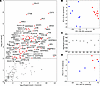
Donnai-Barrow syndrome (DBS) arises from loss-of-function (LoF) variants in the endocytic receptor low-density lipoprotein receptor–related protein 2 (LRP2; or megalin) and is characterized by low–molecular weight proteinuria and developmental abnormalities. Urinary proteomics of 9 patients with DBS revealed that the urinary proteome of a DBS patient with the missense variant LRP2 p.C1400R was indistinguishable from that of patients with splice site, nonsense, or frameshift mutations. A CRISPR mouse model of the variant was generated to determine the mechanism of LoF and proteinuria. The mutant LRP2 was expressed and observed to dimerize and localize to the proximal tubule apical membrane. However, both fluid-phase and receptor-mediated endocytosis was impaired in the context of a general perturbation of endocytic flux. Immunofluorescence revealed aberrant endocytic recycling with mislocalized RAB11+ and TFR1+ compartments and enlarged lysosomes. Structural modeling showed that the LRP2 assembly likely tolerates the cysteine-to-arginine substitution at the cell surface, but at endosomal pH the variant introduced steric clashes that may disrupt intramolecular interfaces and disturb receptor recycling. These findings point to the importance of LRP2 recycling for global endocytic flux and offer a blueprint for leveraging patient-specific alleles to dissect proximal tubule function.
Authors
Andrew Beenken, Tian H. Shen, Aryan Ghotra, Hediye Erdjument-Bromage, Jeong Lee, Jared S. Kushner, Rachel E. Sturley, Atlas Khan, Jeffrey R. Arace, Leora Kronenberg, Lucy D. Shen, Gabriel H. Rahmani, Patricia K. Donahoe, Thomas A. Neubert, Frances A. High, Ora A. Weisz, Jonathan Barasch
This file is in Adobe Acrobat (PDF) format. If you have not installed and configured the Adobe Acrobat Reader on your system.
Having trouble reading a PDF?
PDFs are designed to be printed out and read, but if you prefer to read them online, you may find it easier if you increase the view size to 125%.
Having trouble saving a PDF?
Many versions of the free Acrobat Reader do not allow Save. You must instead save the PDF from the JCI Online page you downloaded it from. PC users: Right-click on the Download link and choose the option that says something like "Save Link As...". Mac users should hold the mouse button down on the link to get these same options.
Having trouble printing a PDF?
- Try printing one page at a time or to a newer printer.
- Try saving the file to disk before printing rather than opening it "on the fly." This requires that you configure your browser to "Save" rather than "Launch Application" for the file type "application/pdf", and can usually be done in the "Helper Applications" options.
- Make sure you are using the latest version of Adobe's Acrobat Reader.


