
Abstract
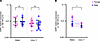
The estrogen receptor (ER) is hypothesized to directly influence HIV transcription and latency but is also critical for immune signaling. However, the mechanisms of action of the ER in immune cells in the context of HIV are limited, and relevant to HIV cure strategies, the influence of latency reversal agents (LRAs) on the ER pathway are unknown. We evaluated (a) the effect of estrogen (E2) on the nuclear translocation of ERα in CD4+ T cells; (b) the ability of Fulvestrant, a selective estrogen receptor degrader (SERD), and ARV-471, a potent, PROteolysis TArgeting Chimera (PROTAC) selective ERα degrader to modulate ERα; and c) the effect of different classes of LRAs on ERα signaling. In contrast to what has been demonstrated in oncology, E2 did not induce ERα nuclear translocation in CD4+ T cells. Similarly, neither Fulvestrant nor ARV-471 induced degradation of ERα in CD4+ T cells. LRAs significantly downregulated ERα gene and protein expression in both PBMCs and CD4+ T cells. Collectively, our results suggest that estrogen influences on HIV transcription are not likely a consequence of canonical nuclear ERα mechanisms. The consequences of LRA downregulation of ERα, a protein important for immune signaling, warrant further investigation.
Authors
Cristina Ceriani, Priya Khetan, Anthony Abeyta-Lopez, Kena J. Lemu, Prachi Meher, Brigitte Allard, Katherine S. James, Anne-Marie W. Turner, David M. Margolis, Nancie M. Archin
This file is in Adobe Acrobat (PDF) format. If you have not installed and configured the Adobe Acrobat Reader on your system.
Having trouble reading a PDF?
PDFs are designed to be printed out and read, but if you prefer to read them online, you may find it easier if you increase the view size to 125%.
Having trouble saving a PDF?
Many versions of the free Acrobat Reader do not allow Save. You must instead save the PDF from the JCI Online page you downloaded it from. PC users: Right-click on the Download link and choose the option that says something like "Save Link As...". Mac users should hold the mouse button down on the link to get these same options.
Having trouble printing a PDF?
- Try printing one page at a time or to a newer printer.
- Try saving the file to disk before printing rather than opening it "on the fly." This requires that you configure your browser to "Save" rather than "Launch Application" for the file type "application/pdf", and can usually be done in the "Helper Applications" options.
- Make sure you are using the latest version of Adobe's Acrobat Reader.


