
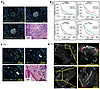
Abstract
Pancreatic cancer is a highly innervated gastrointestinal disease in which sympathetic nerves play a critical role in modulating tumor growth and the tumor microenvironment (TME). While recent studies suggest that sympathetic nerves influence various TME components, including lymphoid and myeloid immune cells, their interactions with cancer-associated fibroblasts (CAFs) remain poorly understood. CAFs are a hallmark of pancreatic tumors and are known to upregulate axon guidance and neuroactive cues, suggesting a potential feedback loop with tumor-innervating nerves. Here, we investigated the bidirectional crosstalk between sympathetic nerves and CAFs in human and mouse pancreatic tumors. Using a chemo-genetic ablation model, we selectively eliminated pancreatic sympathetic nerves and found that denervation significantly reduced tumor size in female mice. To further dissect this interaction, we established coculture systems with immortalized pancreatic fibroblasts and primary sympathetic neuron explants, identifying key transcriptional changes driven by CAF–sympathetic nerve signaling. Our findings demonstrated that sympathetic signaling enhanced CAF activation and extracellular matrix remodeling, while activated CAFs, in turn, induced transcriptional programs in sympathetic neurons associated with nerve injury response. These results establish CAFs as central mediators of the tumor-supportive role of sympathetic nerves, offering further insights into the neural regulation of pancreatic cancer progression.
Authors
Ariana L. Sattler, Parham Diba, Kevin Hawthorne, Carl Pelz, Joe Grieco, Tetiana Korzun, Bryan Chong, M.J. Kuykendall, Rosalie C. Sears, Daniel L. Marks, Mara H. Sherman, Teresa A. Zimmers, S. Ece Eksi
This file is in Adobe Acrobat (PDF) format. If you have not installed and configured the Adobe Acrobat Reader on your system.
Having trouble reading a PDF?
PDFs are designed to be printed out and read, but if you prefer to read them online, you may find it easier if you increase the view size to 125%.
Having trouble saving a PDF?
Many versions of the free Acrobat Reader do not allow Save. You must instead save the PDF from the JCI Online page you downloaded it from. PC users: Right-click on the Download link and choose the option that says something like "Save Link As...". Mac users should hold the mouse button down on the link to get these same options.
Having trouble printing a PDF?
- Try printing one page at a time or to a newer printer.
- Try saving the file to disk before printing rather than opening it "on the fly." This requires that you configure your browser to "Save" rather than "Launch Application" for the file type "application/pdf", and can usually be done in the "Helper Applications" options.
- Make sure you are using the latest version of Adobe's Acrobat Reader.


