
Submit a comment
Abstract
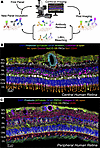
We generated a comparative spatial proteomic atlas of the human and mouse retina using a highly multiplexed immunohistochemistry technique called iterative bleaching extends multiplexity (IBEX). We refined the IBEX workflow by integrating an antibody dissociation option alongside chemical bleaching. This dual strategy enabled removal of the entire antibody complex, permitting the flexible use of antibodies from the same host species across iterative cycles. We coupled this workflow with super-resolution imaging via deconvolution and applied it to the retina of healthy humans and WT mice and the Crb1rd8 mouse model. We successfully imaged over 25 protein markers on human and mouse tissue sections, generating spatial atlases of the major retinal cell populations. Cross-species protein expression was compared to scRNA-seq datasets to identify protein and transcript disparities. Super-resolution IBEX delineated the ultrastructural features of the outer limiting membrane (OLM), identifying CD44 as a core structural component tightly colocalized with a highly organized F-actin belt within Müller glial endfeet. Using the Crb1rd8 mouse model, disruption of this complex was spatially associated with rosette formation and OLM structural failure. In summary, spatial proteomic atlases of the human and mouse retina were used to reveal insights into the arrangement of major retinal cell populations and OLM structure.
Authors
Yuxuan Meng, Jakub Kubiak, Zuzanna Dzieniak, Lorna Fowler, Rose Avient, Jason Hopley, Linyulong Li, Chaoran Li, Yuan Tian, Bruno Charbit, Colin J. Chu
Guidelines
The Editorial Board will only consider comments that are deemed relevant and of interest to readers. The Journal will not post data that have not been subjected to peer review; or a comment that is essentially a reiteration of another comment.
- Comments appear on the Journal’s website and are linked from the original article’s web page.
- Authors are notified by email if their comments are posted.
- The Journal reserves the right to edit comments for length and clarity.
- No appeals will be considered.
- Comments are not indexed in PubMed.
Specific requirements
- Maximum length, 400 words
- Entered as plain text or HTML
- Author’s name and email address, to be posted with the comment
- Declaration of all potential conflicts of interest (even if these are not ultimately posted); see the Journal’s conflict-of-interest policy
- Comments may not include figures


