
Submit a comment
Abstract
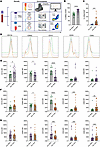
Sepsis is a leading cause of death for which host-directed therapies are urgently needed. We performed high-dimensional flow cytometry, measurement of soluble biomarkers, and lipopolysaccharide (LPS) stimulation of neutrophils to characterize neutrophil heterogeneity and function in patients with sepsis. We observed that in patients with sepsis, low-density neutrophils (LDNs) are elevated and phenotypically diverse populations of innate immune cells with varying degrees of maturity and myeloperoxidase expression. Spleen tyrosine kinase (SYK) expression was found to be higher in whole blood neutrophils and LDNs of patients with sepsis compared with healthy donors. Importantly, SYK+ LDNs associated with increased levels of intracellular myeloperoxidase (MPO) and soluble biomarkers. Furthermore, SYK+ LDNs correlated with clinical outcomes of sepsis disease severity, including sequential organ failure assessment score, mechanical ventilation, and vasopressors. Functionally, the SYK inhibitor R406 suppressed changes in neutrophil features of activation from normal-density neutrophils and LDNs, including the SYK+ and SYK– neutrophil subsets, and MPO release from LDNs following LPS stimulation of sepsis neutrophils. Combined, these results establish LDNs as a heterogenous population of neutrophils that express high levels of SYK and support SYK inhibition as a potentially novel therapeutic target aimed at suppressing overactive neutrophils in sepsis.
Authors
Heather L. Teague, Lauren Knabe, Raquel S. Da Cruz, Xianglan Yao, Kiana C. Allen, Trenton Williams, Cumhur Y. Demirkale, Merte Woldehanna, Ernest Evans, Amir Hobson, Jared D. Wilkinson, Steven D. Nathan, Christopher S. King, Jeffrey R. Strich
Guidelines
The Editorial Board will only consider comments that are deemed relevant and of interest to readers. The Journal will not post data that have not been subjected to peer review; or a comment that is essentially a reiteration of another comment.
- Comments appear on the Journal’s website and are linked from the original article’s web page.
- Authors are notified by email if their comments are posted.
- The Journal reserves the right to edit comments for length and clarity.
- No appeals will be considered.
- Comments are not indexed in PubMed.
Specific requirements
- Maximum length, 400 words
- Entered as plain text or HTML
- Author’s name and email address, to be posted with the comment
- Declaration of all potential conflicts of interest (even if these are not ultimately posted); see the Journal’s conflict-of-interest policy
- Comments may not include figures


