
Submit a comment
Abstract
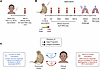
The immune mechanisms induced by the Bacillus Calmette-Guérin (BCG) vaccine, and the subset of which that mediate protection against tuberculosis (TB), remain poorly understood. This is further complicated by difficulties in verifying vaccine-induced protection in humans. Although research in animal models, namely mice and nonhuman primates (NHPs), has begun to close this knowledge gap, discrepancies in the relative importance of biological pathways across species limit the utility of animal model–derived biological insights in humans. To address these challenges, we applied a systems modeling framework, Translatable Components Regression (TransCompR), to identify human blood transcriptional variability that could predict Mycobacterium tuberculosis challenge outcomes in BCG-vaccinated NHPs. These protection-associated pathways included both innate and adaptive immune activation mechanisms, along with signaling via type I IFNs and antimycobacterial Th cytokines. We further partially validated the associations between these mechanisms and protection in humans using publicly available microarray data collected from BCG-vaccinated infants who either developed TB or remained healthy during 2 years of follow-up. Overall, our work demonstrates how species translation modeling can leverage animal studies to generate hypotheses about the mechanisms that underlie human infectious disease and vaccination outcomes, which may be difficult or impossible to ascertain using human data alone.
Authors
Kate Bridges, Denis Awany, Anele Gela, Temwa-Dango Mwambene, Sherry L. Kurtz, Richard E. Baker, Karen L. Elkins, Christopher M. Sassetti, Thomas J. Scriba, Douglas A. Lauffenburger
Guidelines
The Editorial Board will only consider comments that are deemed relevant and of interest to readers. The Journal will not post data that have not been subjected to peer review; or a comment that is essentially a reiteration of another comment.
- Comments appear on the Journal’s website and are linked from the original article’s web page.
- Authors are notified by email if their comments are posted.
- The Journal reserves the right to edit comments for length and clarity.
- No appeals will be considered.
- Comments are not indexed in PubMed.
Specific requirements
- Maximum length, 400 words
- Entered as plain text or HTML
- Author’s name and email address, to be posted with the comment
- Declaration of all potential conflicts of interest (even if these are not ultimately posted); see the Journal’s conflict-of-interest policy
- Comments may not include figures


