
Submit a comment
Abstract
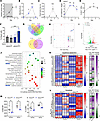
Induction of heme oxygenase-1 (HO-1/Hmox1) is broadly considered cytoprotective, but the role of colonic epithelial HO-1 in colitis-associated tumorigenesis is poorly defined. HO-1 catabolizes heme, releasing ferrous iron, a key driver of oxidative stress and lipid peroxidation. We observed that colonic epithelial HO-1 was induced during colitis and tumorigenesis. We also found that HO-1 was upregulated in ferroptosis-inducing conditions in murine and human colonic epithelial organoids and correlated with lipid peroxidation and ferroptosis markers in colonic tumors. In colonic epithelial organoids exposed to heme, deletion of Hmox1 amplified a compensatory oxidative stress and detoxification transcriptional program, likely reflecting unresolved oxidative and nonoxidative toxicity from heme. In vivo, epithelial HO-1–deficient mice developed significantly fewer and smaller tumors compared with littermate controls in a colitis-associated tumorigenesis model, despite similar inflammatory injury. Tumors from KO mice exhibited reduced iron levels, decreased lipid peroxidation, lower oxidative DNA damage, and decreased proliferation. Single-cell RNA sequencing of tumor epithelial cells revealed a shift from a proliferative to a stress-adaptive program with loss of HO-1. These findings identify epithelial HO-1 as a context-dependent regulator of tumorigenesis: it is protective against acute heme toxicity but promotes iron-dependent oxidative damage and proliferation in the setting of chronic inflammation.
Authors
Rosemary C. Callahan, Jillian C. Curry, Geetha Bhagavatula, Alyse W. Staley, Rachel E.M. Schaefer, Faiz Minhajuddin, Liheng Zhou, Rane M. Neuhart, Shaikh M. Atif, David J. Orlicky, Ian M. Cartwright, Mark E. Gerich, Calen A. Steiner, Arianne L. Theiss, Caroline H.T. Hall, Sean P. Colgan, Joseph C. Onyiah
Guidelines
The Editorial Board will only consider comments that are deemed relevant and of interest to readers. The Journal will not post data that have not been subjected to peer review; or a comment that is essentially a reiteration of another comment.
- Comments appear on the Journal’s website and are linked from the original article’s web page.
- Authors are notified by email if their comments are posted.
- The Journal reserves the right to edit comments for length and clarity.
- No appeals will be considered.
- Comments are not indexed in PubMed.
Specific requirements
- Maximum length, 400 words
- Entered as plain text or HTML
- Author’s name and email address, to be posted with the comment
- Declaration of all potential conflicts of interest (even if these are not ultimately posted); see the Journal’s conflict-of-interest policy
- Comments may not include figures


