
Go to The Journal of Clinical Investigation
  • About
  • Editors
  • Consulting Editors
  • For authors
  • Publication ethics
  • Publication alerts by email
  • Transfers
  • Advertising
  • Job board
  • Contact
  • Physician-Scientist Development
  • Current issue
  • Past issues
  • By specialty
    • COVID-19
    • Cardiology
    • Immunology
    • Metabolism
    • Nephrology
    • Oncology
    • Pulmonology
    • All ...
  • Videos
  • Collections
    • In-Press Preview
    • Resource and Technical Advances
    • Clinical Research and Public Health
    • Research Letters
    • Editorials
    • Perspectives
    • Physician-Scientist Development
    • Reviews
    • Top read articles

  • Current issue
  • Past issues
  • Specialties
  • In-Press Preview
  • Resource and Technical Advances
  • Clinical Research and Public Health
  • Research Letters
  • Editorials
  • Perspectives
  • Physician-Scientist Development
  • Reviews
  • Top read articles
  • About
  • Editors
  • Consulting Editors
  • For authors
  • Publication ethics
  • Publication alerts by email
  • Transfers
  • Advertising
  • Job board
  • Contact
Clonal relationships of CSF B cells in treatment-naive multiple sclerosis patients
Erica L. Eggers, Brady A. Michel, Hao Wu, Sheng-zhi Wang, Carolyn J. Bevan, Aya Abounasr, Natalie S. Pierson, Antje Bischof, Max Kazer, Elizabeth Leitner, Ariele L. Greenfield, Stanislas Demuth, Michael R. Wilson, Roland G. Henry, Bruce A.C. Cree, Stephen L. Hauser, H.-Christian von Büdingen
View: Text | PDF
Research Article Neuroscience

Clonal relationships of CSF B cells in treatment-naive multiple sclerosis patients

  • Text
  • PDF
Abstract

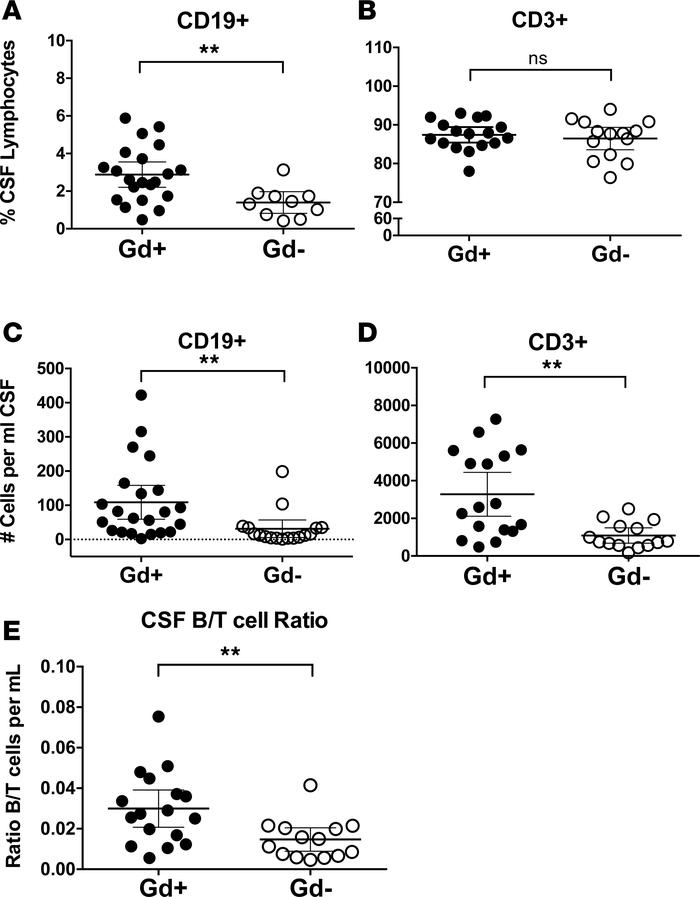
A role of B cells in multiple sclerosis (MS) is well established, but there is limited understanding of their involvement during active disease. Here, we examined cerebrospinal fluid (CSF) and peripheral blood (PB) B cells in treatment-naive patients with MS or high-risk clinically isolated syndrome. Using flow cytometry, we found increased CSF lymphocytes with a disproportionate increase of B cells compared with T cells in patients with gadolinium-enhancing (Gd+) lesions on brain MRI. Ig gene heavy chain variable region (Ig-VH) repertoire sequencing of CSF and PB B cells revealed clonal relationships between intrathecal and peripheral B cell populations, which could be consistent with migration of B cells to and activation in the CNS in active MS. In addition, we found evidence for bystander immigration of B cells from the periphery, which could be supported by a CXCL13 gradient between CSF and blood. Understanding what triggers B cells to migrate and home to the CNS may ultimately aid in the rational selection of therapeutic strategies to limit progression in MS.

Authors

Erica L. Eggers, Brady A. Michel, Hao Wu, Sheng-zhi Wang, Carolyn J. Bevan, Aya Abounasr, Natalie S. Pierson, Antje Bischof, Max Kazer, Elizabeth Leitner, Ariele L. Greenfield, Stanislas Demuth, Michael R. Wilson, Roland G. Henry, Bruce A.C. Cree, Stephen L. Hauser, H.-Christian von Büdingen

×

Figure 1

CSF lymphocytes are dominated by T cells, but B cells are disproportionately increased in active MS.
Options: View larger image (or click on image) Download as PowerPoint
CSF lymphocytes are dominated by T cells, but B cells are disproportiona...
While most CSF lymphocytes are T cells, the overall proportion of B cells (CD19) (A) but not of T cells (CD3) (B) is significantly increased in Gd+ versus Gd– patients. Reflective of an inflammatory state during active MS, the absolute numbers of both B cells (C) and T cells (D) are increased in Gd+ patients. However, there is a disproportionate increase in B cells versus T cells in active disease, as indicated by a significantly higher B/T cell ratio, based on cell number per ml in Gd+ patients (E). Shown are data from patients with active MS (Gd+ lesions on brain MRI) and without Gd-enhancing (Gd–) lesions. Refer to Supplemental Table 1 for more information on the patients analyzed. Data are shown as scatter plots with mean ± 95% CI. Comparisons were made using an unpaired t test (GraphPad Prism); **P < 0.01, ****P < 0.0001.

Copyright © 2026 American Society for Clinical Investigation
ISSN 2379-3708

Sign up for email alerts