
Go to The Journal of Clinical Investigation
  • About
  • Editors
  • Consulting Editors
  • For authors
  • Publication ethics
  • Publication alerts by email
  • Transfers
  • Advertising
  • Job board
  • Contact
  • Physician-Scientist Development
  • Current issue
  • Past issues
  • By specialty
    • COVID-19
    • Cardiology
    • Immunology
    • Metabolism
    • Nephrology
    • Oncology
    • Pulmonology
    • All ...
  • Videos
  • Collections
    • In-Press Preview
    • Resource and Technical Advances
    • Clinical Research and Public Health
    • Research Letters
    • Editorials
    • Perspectives
    • Physician-Scientist Development
    • Reviews
    • Top read articles

  • Current issue
  • Past issues
  • Specialties
  • In-Press Preview
  • Resource and Technical Advances
  • Clinical Research and Public Health
  • Research Letters
  • Editorials
  • Perspectives
  • Physician-Scientist Development
  • Reviews
  • Top read articles
  • About
  • Editors
  • Consulting Editors
  • For authors
  • Publication ethics
  • Publication alerts by email
  • Transfers
  • Advertising
  • Job board
  • Contact

Citations to this article
Macrophage signaling associates with fibrogenic program activation in periductal fibroblasts in pediatric primary sclerosing cholangitis
Yunguan Wang, David Adeleke, Xiangfei Xie, Zi F. Yang, Xiangya Wang, Giulia Loi, Annika Yang vom Hofe, Manavi Singh, Astha Malik, Ramesh Kudira, Cyd Castro-Rojas, Liva Pfuhler, Mosab Alquraish, Pamela Sylvestre, Jonathan R. Dillman, Andrew T. Trout, Emily R. Miraldi, Alexander G. Miethke
View: Text | PDF
Research Article Gastroenterology

Macrophage signaling associates with fibrogenic program activation in periductal fibroblasts in pediatric primary sclerosing cholangitis

  • Text
  • PDF
Abstract

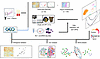
Primary sclerosing cholangitis (PSC) is a chronic, idiopathic cholestatic liver disease characterized by inflammation and fibrosis of the bile ducts, yet the cellular crosstalk driving periductal fibrosis remains poorly defined. This study applied a multiomics approach integrating spatial transcriptomics, RNA-Seq, and proteomics to characterize fibrotic periductal regions and their cell-cell communications. Macrophage subsets, including monocyte-derived macrophages and lipid-associated macrophage–like cells, colocalized with cholangiocytes, lymphocytes, and hepatic stellate cells (HSCs). Cell niche analysis identified periductal regions with elevated fibrotic signals, where cell-cell communication analysis revealed potential macrophage-HSC interactions involving 17 fibrotic driver genes in macrophages, including ITGB2, GRN, and CCL21, and 6 fibrotic effector genes in HSCs. In validation analyses, bulk RNA-Seq data showed higher driver and effector gene expression in PSC with established fibrosis compared with early-stage PSC or healthy controls. Plasma proteins encoded by macrophage driver genes were elevated in PSC and in patients with elevated (≥3.29 kPa) liver stiffness on MR elastography. Immunofluorescence and second harmonic generation imaging showed enrichment of CD68+/CD18+(ITGB2) macrophages in fibrotic regions of PSC liver biopsies. These findings revealed enrichment of monocyte-derived macrophages and lipid-associated macrophage–like cells in fibrotic regions and suggest that they likely contribute to fibrotic activation of nearby HSCs in PSC.

Authors

Yunguan Wang, David Adeleke, Xiangfei Xie, Zi F. Yang, Xiangya Wang, Giulia Loi, Annika Yang vom Hofe, Manavi Singh, Astha Malik, Ramesh Kudira, Cyd Castro-Rojas, Liva Pfuhler, Mosab Alquraish, Pamela Sylvestre, Jonathan R. Dillman, Andrew T. Trout, Emily R. Miraldi, Alexander G. Miethke

×

Loading citation information...
Advertisement

Copyright © 2026 American Society for Clinical Investigation
ISSN 2379-3708

Sign up for email alerts