
Research ArticleImmunologyInflammationOncology
Open Access |  10.1172/jci.insight.195329
TLR2 signaling regulates T cell exclusion in pancreatic ductal adenocarcinoma
Jacqueline Plesset,1,2 Meredith L. Stone,1,2 John C. McVey,1,3 Heather Coho,1,2 Kelly Markowitz,1,2 Kayjana Coho,1,2 Jesse Lee,1,2 Anna S. Thickens,1,2 Devora Delman,1,2 and Gregory L. Beatty1,2
1Abramson Cancer Center, University of Pennsylvania, Philadelphia, Pennsylvania, USA.
2Division of Hematology-Oncology, Department of Medicine, and
3Department of Surgery, Perelman School of Medicine, University of Pennsylvania, Philadelphia, Pennsylvania, USA.
Address correspondence to: Gregory L. Beatty, Perelman School of Medicine, University of Pennsylvania 3400 Civic Center Blvd., South Pavilion, Rm 8-107, Philadelphia, Pennsylvania, 19104, USA. Email: gregory.beatty@pennmedicine.upenn.edu.
Authorship note: JP, MLS, and JCM contributed equally to this work.
Find articles by Plesset, J. in: PubMed | Google Scholar
1Abramson Cancer Center, University of Pennsylvania, Philadelphia, Pennsylvania, USA.
2Division of Hematology-Oncology, Department of Medicine, and
3Department of Surgery, Perelman School of Medicine, University of Pennsylvania, Philadelphia, Pennsylvania, USA.
Address correspondence to: Gregory L. Beatty, Perelman School of Medicine, University of Pennsylvania 3400 Civic Center Blvd., South Pavilion, Rm 8-107, Philadelphia, Pennsylvania, 19104, USA. Email: gregory.beatty@pennmedicine.upenn.edu.
Authorship note: JP, MLS, and JCM contributed equally to this work.
Find articles by Stone, M. in: PubMed | Google Scholar
1Abramson Cancer Center, University of Pennsylvania, Philadelphia, Pennsylvania, USA.
2Division of Hematology-Oncology, Department of Medicine, and
3Department of Surgery, Perelman School of Medicine, University of Pennsylvania, Philadelphia, Pennsylvania, USA.
Address correspondence to: Gregory L. Beatty, Perelman School of Medicine, University of Pennsylvania 3400 Civic Center Blvd., South Pavilion, Rm 8-107, Philadelphia, Pennsylvania, 19104, USA. Email: gregory.beatty@pennmedicine.upenn.edu.
Authorship note: JP, MLS, and JCM contributed equally to this work.
Find articles by McVey, J. in: PubMed | Google Scholar
1Abramson Cancer Center, University of Pennsylvania, Philadelphia, Pennsylvania, USA.
2Division of Hematology-Oncology, Department of Medicine, and
3Department of Surgery, Perelman School of Medicine, University of Pennsylvania, Philadelphia, Pennsylvania, USA.
Address correspondence to: Gregory L. Beatty, Perelman School of Medicine, University of Pennsylvania 3400 Civic Center Blvd., South Pavilion, Rm 8-107, Philadelphia, Pennsylvania, 19104, USA. Email: gregory.beatty@pennmedicine.upenn.edu.
Authorship note: JP, MLS, and JCM contributed equally to this work.
Find articles by Coho, H. in: PubMed | Google Scholar
1Abramson Cancer Center, University of Pennsylvania, Philadelphia, Pennsylvania, USA.
2Division of Hematology-Oncology, Department of Medicine, and
3Department of Surgery, Perelman School of Medicine, University of Pennsylvania, Philadelphia, Pennsylvania, USA.
Address correspondence to: Gregory L. Beatty, Perelman School of Medicine, University of Pennsylvania 3400 Civic Center Blvd., South Pavilion, Rm 8-107, Philadelphia, Pennsylvania, 19104, USA. Email: gregory.beatty@pennmedicine.upenn.edu.
Authorship note: JP, MLS, and JCM contributed equally to this work.
Find articles by Markowitz, K. in: PubMed | Google Scholar
1Abramson Cancer Center, University of Pennsylvania, Philadelphia, Pennsylvania, USA.
2Division of Hematology-Oncology, Department of Medicine, and
3Department of Surgery, Perelman School of Medicine, University of Pennsylvania, Philadelphia, Pennsylvania, USA.
Address correspondence to: Gregory L. Beatty, Perelman School of Medicine, University of Pennsylvania 3400 Civic Center Blvd., South Pavilion, Rm 8-107, Philadelphia, Pennsylvania, 19104, USA. Email: gregory.beatty@pennmedicine.upenn.edu.
Authorship note: JP, MLS, and JCM contributed equally to this work.
Find articles by Coho, K. in: PubMed | Google Scholar
1Abramson Cancer Center, University of Pennsylvania, Philadelphia, Pennsylvania, USA.
2Division of Hematology-Oncology, Department of Medicine, and
3Department of Surgery, Perelman School of Medicine, University of Pennsylvania, Philadelphia, Pennsylvania, USA.
Address correspondence to: Gregory L. Beatty, Perelman School of Medicine, University of Pennsylvania 3400 Civic Center Blvd., South Pavilion, Rm 8-107, Philadelphia, Pennsylvania, 19104, USA. Email: gregory.beatty@pennmedicine.upenn.edu.
Authorship note: JP, MLS, and JCM contributed equally to this work.
Find articles by Lee, J. in: PubMed | Google Scholar
1Abramson Cancer Center, University of Pennsylvania, Philadelphia, Pennsylvania, USA.
2Division of Hematology-Oncology, Department of Medicine, and
3Department of Surgery, Perelman School of Medicine, University of Pennsylvania, Philadelphia, Pennsylvania, USA.
Address correspondence to: Gregory L. Beatty, Perelman School of Medicine, University of Pennsylvania 3400 Civic Center Blvd., South Pavilion, Rm 8-107, Philadelphia, Pennsylvania, 19104, USA. Email: gregory.beatty@pennmedicine.upenn.edu.
Authorship note: JP, MLS, and JCM contributed equally to this work.
Find articles by Thickens, A. in: PubMed | Google Scholar
1Abramson Cancer Center, University of Pennsylvania, Philadelphia, Pennsylvania, USA.
2Division of Hematology-Oncology, Department of Medicine, and
3Department of Surgery, Perelman School of Medicine, University of Pennsylvania, Philadelphia, Pennsylvania, USA.
Address correspondence to: Gregory L. Beatty, Perelman School of Medicine, University of Pennsylvania 3400 Civic Center Blvd., South Pavilion, Rm 8-107, Philadelphia, Pennsylvania, 19104, USA. Email: gregory.beatty@pennmedicine.upenn.edu.
Authorship note: JP, MLS, and JCM contributed equally to this work.
Find articles by Delman, D. in: PubMed | Google Scholar
1Abramson Cancer Center, University of Pennsylvania, Philadelphia, Pennsylvania, USA.
2Division of Hematology-Oncology, Department of Medicine, and
3Department of Surgery, Perelman School of Medicine, University of Pennsylvania, Philadelphia, Pennsylvania, USA.
Address correspondence to: Gregory L. Beatty, Perelman School of Medicine, University of Pennsylvania 3400 Civic Center Blvd., South Pavilion, Rm 8-107, Philadelphia, Pennsylvania, 19104, USA. Email: gregory.beatty@pennmedicine.upenn.edu.
Authorship note: JP, MLS, and JCM contributed equally to this work.
Find articles by
Beatty, G.
in:
PubMed
|
Google Scholar
|

Published April 3, 2026 - More info
JCI Insight. 2026;11(10):e195329. https://doi.org/10.1172/jci.insight.195329.
© 2026 Plesset et al. This work is licensed under the Creative Commons Attribution 4.0 International License. To view a copy of this license, visit http://creativecommons.org/licenses/by/4.0/.
Received: May 5, 2025; Accepted: March 19, 2026


-
Results
Preexisting T cell infiltration determines the efficacy of adoptive T cell therapy in PDAC. To study the effect of T cell infiltration on the efficacy of immunotherapy, we investigated PDAC cell lines derived from the LSL-KrasG12D/+ LSL-Trp53R172H/+ Pdx-1-Cre (KPC) mouse model that coordinate a T cell inflamed (T cellhi) or noninflamed (T celllo) TME. These cell lines have been characterized by flow cytometry and IHC, and have been used as models of T cellhi and T celllo phenotypes in prior publications from our laboratory and others (13–15). Cell lines with both T cellhi and T celllo phenotypes expressed comparable levels of the tumor-antigen mesothelin and were lysed in vitro by mesothelin-specific chimeric antigen receptor (meso-CAR) T cells (Figure 1A and Supplemental Figure 1, A and B; supplemental material available online with this article; https://doi.org/10.1172/jci.insight.195329DS1). We next tested the capacity of meso-CAR T cells to infiltrate and slow tumor growth in C57BL/6 (WT) mice implanted with T cellhi and T celllo tumors. To enhance CAR T cell engraftment, tumor-bearing mice were treated on day –1 with a single 120 mg/kg dose of cyclophosphamide (Cy). This treatment induces transient lymphodepletion, reducing multiple lymphocyte populations and creating a more permissive immune environment for CAR T cell engraftement and expansion. On days 0 and 7, mice were treated with or without meso-CAR T cells (Figure 1B). Meso-CAR T cells were found to infiltrate T cellhi but not T celllo tumors (Figure 1C). Consistent with this, meso-CAR T cell treatment slowed tumor growth and prolonged overall survival in T cellhi tumors (Figure 1, D–F, and Supplemental Figure 1, C and D). However, in T celllo tumors, meso-CAR T cell therapy did not significantly affect tumor growth or have a significant effect on overall survival (Figure 1, G–I, and Supplemental Figure 1, E and F). Further analysis of the tumors showed that mice bearing T cellhi tumors had an increase in T cell density after Meso-CAR T cell therapy that was not observed in mice bearing T celllo tumors (Figure 1, J and K). Analysis of meso-CAR T cells in the blood showed comparable CAR T cell frequencies in both tumor models, indicating that the observed therapeutic differences were not attributable to differences in T cell engraftment or persistence in vivo (Supplemental Figure 1, G and H). Together, these findings support a role for the preexisting TME, rather than insufficient tumor-specific T cells, as a rate limiting determinant of the efficacy of immunotherapy in PDAC.
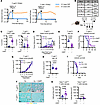 Figure 1
The immune microenvironment in PDAC determines adoptive T cell infiltration and efficacy. (A) In vitro xcelligence T cellhi (2838c3) and T celllo (PDA.69) tumor cell survival after mesothelin or mock CAR T cells treatment (9:1 E:T). (B) Study design of C–K. T cellhi or T celllo cells (1 × 10⁶) were implanted s.c. into WT mice (n = 5–8/group) on day –14. Mice received cyclophosphamide (120 mg/kg dose, i.p.) on day –1, followed by meso CAR-T cell infusions (5 × 10⁶ to 8 × 10⁶ cells/mouse, i.v.) on days 0 and 7. Data shown in C–K are representative of n = 2 experimental replicates. (C) Meso-CAR T cell trafficking in Cy versus Cy + CAR T cell–treated T cellhi and T celllo tumors (Mann-Whitney U test performed). (D) Tumor growth curve (2-way ANOVA performed), (E) tumor volumes at day 24 (Mann-Whitney U test performed), and (F) overall survival curve (Mantel-Cox test performed) of mice bearing T cellhi tumors treated with Cy or Cy + meso-CAR T cells. (G) Tumor growth curve (2-way ANOVA performed), (H) tumor volumes at day 18 (Mann-Whitney U test performed), and (I) overall survival curve (Mantel-Cox test performed) of mice bearing T celllo tumors treated with Cy or Cy + meso-CAR T cells. (J) Representative images of tumors stained for CD3 (pink), Ki67 (yellow) ,and CK19 (blue). Scale bar: 100 μm. (K) Analysis of T cell Density (CD3+) from J (Mann-Whitney U test performed).
TLR2 expression correlates with T cell infiltration in human and mouse PDAC. To identify factors within the TME that contribute to T cell infiltration versus exclusion, we analyzed RNA-seq obtained from tumors orthotopically implanted with T cellhi and T celllo cell lines (Figure 2A). Differential expression analysis revealed 3,203 genes upregulated in T cellhi tumors and 2,959 upregulated genes in T celllo tumors (Supplemental Figure 2A and Supplemental Table 4). We studied innate signaling pathways (16), including TLR pathways, and their relationship with CD3+ T cell infiltration (Figure 2B). Among a set of 38 genes related to these pathways (Figure 2B), we identified 8 differentially expressed genes. Notably, among the TLR pathways, only TLR1 and TLR2 were significantly different with increased expression detected in T cellhi tumors compared with T celllo tumors (Figure 2C and Supplemental Figure 2, B–K). Given that TLR1 is known to form a heterodimer with TLR2 (17, 18), we focused our subsequent studies on TLR2. We examined tumor-infiltrating immune cells for TLR2 expression by flow cytometry. This analysis revealed a significant increase in TLR2+ CD8+ T cells and TLR2+ F4/80+ macrophages in T cellhi tumors compared with T celllo tumors. No difference was observed in TLR2+CD11c+F4/80– DCs (Figure 2, D–G). To investigate potential TLR2 ligands within tumors, we assessed expression of multiple known TLR2 ligands and found Hmgb1 and Has3 significantly elevated in T celllo compared with T cellhi tumors (Supplemental Figure 2L). Together, these findings show that TLR2 expression is increased in T cellhi versus T celllo tumors and is present on multiple immune cell subsets within the TME.
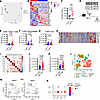 Figure 2
Innate immune signaling molecules correlate with increased tumor immune infiltration in PDAC. (A) PCA plot of T cellhi versus T celllo bulk tumor RNA-seq. (B) Innate signaling pathway heatmap of T cellhi versus T celllo bulk tumor RNA-seq. (C) Normalized TLR2 DESeq expression from bulk RNA-seq data (Mann-Whitney U test performed). (D) Study design of T cellhi versus T celllo end point study. T cellhi (2838c3) or T celllo (PDA.69) cells (1 × 10⁶) were implanted s.c. into Tlr2+/+ mice (n = 8/group) on Day 0. Tumors were extracted with necropsy on day 20. (E) CD8+TLR2+ T cell (CD45+CD3+CD8+TLR2+) per gram. Data shown is n = 3 experimental replicates (Mann-Whitney U test performed). (F) TLR2+ macrophages (CD45+CD11b+F480+CD3–CD19–Ly6G– TLR2+) per gram. Data shown is n = 2 experimental replicates (Mann-Whitney U test performed). (G) TLR2+ DCs (CD45+CD11c+F480–CD3–CD19–Ly6G– TLR2+) per gram. Data shown is n = 3 experimental replicates (Mann-Whitney U test performed). (H) Heatmap of TCGA data of n = 172 patients with pancreas cancer. (I) Gene correlation plot of TCGA data. (J and K) Normalized TLR2 RNA Expression of high (quartiles 3 and 4) versus low (quartiles 1 and 2) CD3E and CD8A gene expression from TCGA data. (L) Labeled UMAP of single cell RNA-seq data taken from 6 PDAC patients. (M) UMAP of TLR2 expression in single cell RNA-seq data divided into T cellhi versus T celllo patients. T cellhi patients: ≥30% of cells found in their tumors are T cells. T celllo patients: ≤10.5% of cells in their tumors are T cells (22). (N) Dot plot of TLR2, CD3E, CD8A, and CD4 genes from single cell RNA-seq dataset.
We next analyzed PDAC tumor samples from The Cancer Genome Atlas (TCGA). Similar to our findings in mice, TLR2 expression positively correlated with T cell markers (CD3E, CD8A, and CD4) in tumors from patients with surgically resected or biopsied pancreas cancer (Figure 2, H and I, and Supplemental Table 5). TLR2 expression also correlated with myeloid cell–associated genes (CD14, BATF3), supporting its presence on various immune cells within the TME (18–20). Consistent with findings in mice, TLR1 also correlated with T cell markers in human PDAC. Additionally, TLR6 significantly correlated with T cell markers in human PDAC (Supplemental Figure 3, A–I), though this was not significant in mice (Supplemental Figure 2). Notably, both TLR1 and TLR6 form heterodimers with TLR2. Tumors with high T cell levels (CD3E and CD8A) also exhibited significantly higher TLR2 expression compared with those with low T cell levels (Figure 2, J and K). Furthermore, among patients with high T cell infiltration, those with concomitant high TLR2 expression showed a trend toward increased median survival (691 days versus 518 days), though this difference was not statistically significant (P = 0.07; Supplemental Figure 3J).
To further test the relationship between TLR2 and T cell infiltration, we categorized human pancreatic cancer samples with publicly available single-cell RNA-seq data (13) into T cellhi (>30% T cells) or T celllo (<10.5% T cells). UMAP clustering revealed enriched TLR2 expression on myeloid cells in the T cellhi group compared with the T celllo group (Figure 2, L and M). Dot plots confirmed increased TLR2 expression specifically in T cellhi samples (Figure 2N). We next analyzed TLR2 signaling in T cells from T cellhi versus T celllo samples. We calculated a TLR1/2 signaling score at single-cell resolution using the AddModuleSocre function in Seurat, applying 115 genes from the “Reactome Toll Like Receptor TLR1 TLR2 Cascade” gene set as a measure of relative TLR1/2 pathway activity. T cells from T celllo tumors showed significantly higher TLR1/2 signaling scores, including across subsets (CD8, CD4, effector CD8, and Tregs), compared with T cellhi tumors (Supplemental Figure 3, K–M). Taken together, these data identify a strong correlation between TLR2 expression and T cell infiltration in PDAC across both human and mouse tumors and suggest that increased TLR2 signaling in T cells may restrict their infiltration into PDAC tumors.
TLR2 regulates T cell activation and tumor infiltration. We previously showed that serum amyloid A proteins 1 and 2 (SAA), which are acute phase reactants secreted by hepatocytes in the liver in the setting of PDAC, engage TLR2 to restrict endogenous T cell infiltration into PDAC tumors (21). Specifically, endogenous T cell infiltration into PDAC tumors was increased in Tlr2–/– compared with Tlr2+/+ mice (21). Based on this, we assessed whether TLR2 expression affects meso-CAR T cell trafficking into PDAC tumors. To do this, we studied Tlr2+/+ and Tlr2–/– mice implanted with T celllo tumors. Tumor-bearing mice were then treated with Cy on day –1, followed by i.v. injection of Tlr2+/+ or Tlr2–/– meso-CAR T cells on day 0 (Figure 3A and Supplemental Figure 4A). IHC and flow cytometry analyses revealed no effect of TLR2 expression on meso-CAR T cell trafficking in Tlr2+/+ mice (Figure 3, B–D), indicating that deleting TLR2 in CAR T cells alone was not sufficient to overcome T cell exclusion. However, in Tlr2–/– mice, deletion of TLR2 in meso-CAR T cells significantly enhanced their infiltration into tumors compared with Tlr2+/+ meso-CAR T cells (Figure 3, B–D). Additionally, Tlr2–/– mice had more Tlr2–/– meso-CAR T cell infiltration compared with Tlr2+/+ mice (Supplemental Figure 4, B and C). These findings indicate that TLR2 expression on both CAR T cells and host cells cooperatively regulate T cell infiltration into tumors, with deletion of TLR2 in both compartments required for optimal T cell infiltration.
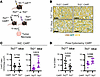 Figure 3
TLR2 expression in both T cells and host cells regulates T cell infiltration in PDAC. (A) Study design of B–D. T celllo (PDA.69) cells where s.c. implanted into Tlr2+/+ and Tlr2–/– mice on day –10. On Day –1, mice received Cy (120 mg/kg dose, i.p.) and then Tlr2+/+ or Tlr2–/– CART cells on day 0 with necropsy 10 days later. (B) Representative images of tumors stained for GFP (teal), CD3 (brown), and CK19 (yellow). Scale bar: 60 μm. (C) Analysis of CART cell densities (GFP stained) from B (n = 7–8/group, Mann-Whitney U test performed). (D) Analysis of CART cell percentages in the tumors via flow cytometry (n = 7–8/group, Mann-Whitney U test performed). In C and D, black represents Tlr2+/+ mice while purple represent Tlr2–/– mice. Open circles represent Tlr2–/– CAR T cells, while closed circles represent Tlr2+/+ CAR T cells.
We next hypothesized that SAA might engage TLR2 on CAR T cells to inhibit their trafficking into PDAC tumors. To test this, we assessed meso-CAR T cell infiltration into T celllo tumors implanted into Saa+/+ and Saa–/– mice (Supplemental Figure 4, D–H). While endogenous T cells were significantly increased in Saa–/– mice, consistent with our prior data (21), no difference in CAR T cell infiltration into PDAC tumors was observed. This finding suggests a role for additional TLR2 ligands, beyond SAA, in specifically regulating meso-CAR T cell trafficking.
TLR2 is a determinant of response to therapy in PDAC. Our findings suggest a role for TLR2 in regulating T cell exclusion in PDAC, thereby prompting us to investigate the therapeutic effect of targeting TLR2. To assess the effect of TLR2 signaling on survival, we implanted T celllo tumor cells into Tlr2+/+ and Tlr2–/– mice (Figure 4A). Tlr2–/– mice exhibited significantly slower tumor growth and increased survival compared with Tlr2+/+ mice (Figure 4, B–D, and Supplemental Figure 5A). This improved outcome was associated with a significant increase in tumor-infiltrating T cells in Tlr2–/– mice (Figure 4, E and F). T cell profiling by IHC showed similar levels of intratumoral CD4+ cells but increased CD8+ cells in Tlr2–/– mice compared with Tlr2+/+ mice (Supplemental Figure 5, B–D). Additional myeloid cell profiling revealed a reduction in CD11b+ myeloid cells in Tlr2–/– mice (Supplemental Figure 5, E and F). Among CD11b+ cells, there were comparable levels of macrophages and DCs but a reduction in Ly6c+ monocytes (Supplemental Figure 5, G–I). We next tested the role of TLR2 in surgical outcomes by performing distal pancreatectomy/splenectomy on Tlr2+/+ versus Tlr2–/– mice with orthotopically implanted T celllo tumors (Figure 4G). Our prior studies showed a role for SAA in reduced survival after surgery but did not define the role of TLR2 (21). Here, SAA protein levels increased in both Tlr2+/+ and Tlr2–/– mice following tumor implantation, indicating that TLR2 is not necessary for SAA secretion in vivo (Figure 4H). Despite this, Tlr2–/– mice still had significantly increased survival (Figure 4I). This finding is consistent with SAA-TLR2 signaling in nonmalignant cells driving tumor progression.
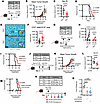 Figure 4
TLR2 is a therapeutic target in PDAC. (A) Study schematic for B–F. T celllo (PDA.69) cells (1 × 10⁶) were implanted s.c. into Tlr2+/+ or Tlr2–/– mice (n = 10/group) on day 0. Data are representative of 1 experiment. (B) Mean tumor growth (2-way ANOVA test performed). (C) Tumor size day 35 (Mann-Whitney U test performed). (D) Overall survival (Mantel-Cox test performed). (E) Representative images of tumors stained for CD3 (pink), Ki67 (yellow), and CK19 (blue). Scale bar: 50 μm. (F) Analysis of T cell (CD3 stained) per tumor area (CK19 stained) from E (Mann-Whitney U test performed). (G) Study schematic for H and I. T celllo (PDA.69) cells (1 × 10⁵) were orthotopically implanted into Tlr2+/+ (n = 8) or Tlr2–/– (n = 7) mice. Ten days later, tumors were surgically resected. Mice were monitored for overall survival. (H) SAA serum level measured by ELISA (Wilcoxon matched pairs signed rank test performed, or Mann-Whitney U test performed for unpaired groups). Data shown are from n = 2 experimental replicates. (I) Overall survival (Mantel-Cox test performed). Data are representative of n = 3 experimental replicates. (J) Study schematic for K–M. Tlr2+/+ mice were treated with aTLR2 (0.2 mg/dose, Sino) on day –2. On day 0, mice were s.c. challenged with T celllo (PDA.69) cells (1 × 10⁶). (K) Mean tumor growth curves (2-way ANOVA test performed). (L) Tumor volume day 26 (Mann-Whitney U test performed). (M) Overall survival (Mantel-Cox test performed). (N) Study schematic for O. On day 0, Tlr2+/+ mice were orthotopically implanted with 5 × 10⁵ T celllo (6694c2) cells. aTLR2 (0.2 mg/dose) was administered i.p. every 3–4 days starting on day –1 (prophylactic, red arrows) or day 10 (therapeutic, blue arrows). (O) Tumor weight on day 15 after tumor implantation (1-way ANOVA with Tukey correction).
Based on the improved survival observed in mice lacking TLR2, we next tested the therapeutic potential of pharmacologically targeting TLR2. We engineered a liver-targeted adeno-associated viral vector (AAV.2/8) expressing an HA-tagged anti-TLR2 scFv compared with GFP under the control of the hepatocyte-specific TBG promoter (Supplemental Figure 6A). Following i.v. administration, successful vector delivery and expression was confirmed 7 days later by detecting the HA tag in the liver, serum, and spleen of Tlr2+/+ mice that had received aTLR2.AAV (Supplemental Figure 6, B–E). Consistent with functional TLR2 inhibition, splenocytes isolated from aTLR2.AAV-treated mice stimulated ex vivo with the TLR2 ligand PAM3CSK4 displayed reduced IL-6 secretion compared with splenocytes from untreated mice (Supplemental Figure 6, B and F). We next administered GFP.AAV or aTLR2.AAV to Tlr2+/+ mice prior to implantation of T celllo tumor cells (Supplemental Figure 6G). Similar to our observations in Tlr2–/– mice, tumors grew significantly slower and survival was increased in aTLR2.AAV-treated mice compared with GFP.AAV-treated controls (Supplemental Figure 6, H–J). Finally, we engineered a full-length aTLR2 antibody on an IgG1 backbone. Tlr2+/+ mice were treated with the aTLR2 antibody starting 2 days prior to T celllo tumor cell implantation, and treatment continued every 3–4 days for 21 days (Figure 4J). Mice receiving aTLR2 showed significantly slower tumor growth and extended survival compared with untreated mice (Figure 4, K–M). To assess therapeutic efficacy, mice were orthotopically implanted with a T celllo tumor and treated with aTLR2 starting 1 day prior to or 10 days after implantation. Prophylactic and therapeutic aTLR2 similarly reduced tumor growth compared with untreated controls (Figure 4, N and O). Collectively, these data identify TLR2 as a therapeutic target for PDAC. In summary, our findings suggest TLR2 as an immune checkpoint that regulates T cell infiltration and tumor growth in PDAC. Our studies support strategies that intervene on TLR2 as an approach to reverse T cell exclusion in PDAC and potentially enhance the efficacy of immunotherapies.


