
Abstract
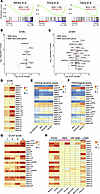
Matrix remodeling by metalloproteinases (MMPs) is essential for maintaining muscle homeostasis; however, their dysregulation can drive degenerative processes. By interrogating biopsy RNA-Seq data, we showed that MMP expression correlated with disease severity in facioscapulohumeral muscular dystrophy (FSHD). In the iDUX4pA FSHD mouse model, MMP levels also progressively increased in response to double homeobox 4–induced (DUX4-induced) muscle degeneration. Single-cell RNA-Seq further identified fibroadipogenic progenitors (FAPs) and macrophages as the primary sources of MMPs, particularly MMP2, MMP14, and MMP19, in dystrophic muscle. Treatment with the pan-MMP inhibitor batimastat alleviated inflammation and fibrosis, improved muscle structure, and decreased the number of FAPs and infiltrating macrophages. These findings underscore the role of MMPs in driving muscle degeneration in FSHD, highlight MMPs as functional biomarkers of disease, and support MMP inhibitors as a DUX4-independent therapeutic approach to limit fibroadipogenesis and promote muscle regeneration.
Authors
Usuk Jung, Erdong Wei, Haseeb Ahsan, Ana Mitanoska, Kenric Chen, Michael Kyba, Darko Bosnakovski
This file is in Adobe Acrobat (PDF) format. If you have not installed and configured the Adobe Acrobat Reader on your system.
Having trouble reading a PDF?
PDFs are designed to be printed out and read, but if you prefer to read them online, you may find it easier if you increase the view size to 125%.
Having trouble saving a PDF?
Many versions of the free Acrobat Reader do not allow Save. You must instead save the PDF from the JCI Online page you downloaded it from. PC users: Right-click on the Download link and choose the option that says something like "Save Link As...". Mac users should hold the mouse button down on the link to get these same options.
Having trouble printing a PDF?
- Try printing one page at a time or to a newer printer.
- Try saving the file to disk before printing rather than opening it "on the fly." This requires that you configure your browser to "Save" rather than "Launch Application" for the file type "application/pdf", and can usually be done in the "Helper Applications" options.
- Make sure you are using the latest version of Adobe's Acrobat Reader.


