
Infectious disease
Abstract
It remains unclear why vaccines targeting prominent microbial virulence factors often fail in clinical trials. Because microbial virulence depends on interaction with the host immune system, we investigated how changes in host immune function alter vaccine efficacy. Using a vaccine against Staphylococcus aureus α-toxin (Hla), which targets host metalloprotease ADAM10 on myeloid cells, we show that Hla virulence is reduced in aged mice due to diminished ADAM10 activity and impaired myeloid cell function. Depletion of myeloid cells with cyclophosphamide in young mice similarly reduced toxin virulence. Immunization against Hla conferred strong protection against S. aureus infection in young but not aged mice. These findings indicate that pathogenic functions of microbial factors characterized in immunocompetent young animals may not predict virulence or vaccine efficacy in immunocompromised hosts. These findings underscore the need to account for host immune status in the development and evaluation of vaccines targeting microbial virulence factors.
Authors
Xin Du, Ching Wen Tseng, Elisabet Bjånes, Hunter Gage, Jaclyn Swan, Chih-Ming Tsai, Irshad A. Hajam, Cesia Gonzalez, Brian Lin, Victor Nizet, George Y. Liu
Abstract
Community-acquired pneumonia is a major cause of morbidity and mortality globally. Specific molecular endotypes are currently not well defined, and different viral or bacterial pathogens may trigger specific host responses and pathogenic mechanisms. We performed longitudinal proteomic profiling of bronchoalveolar lavage fluid and plasma from bacterial, influenza, and SARS-CoV-2–driven pneumonia. Our analysis revealed highly pneumonia type–specific proteomic signatures, including COVID-19–specific antibodies locally produced in the lung. These antibodies showed biased immunoglobulin V–domain usage, linked to a CD69/CD83 plasma cell state associated with disease severity and degree of autoimmunity. Using mass spectrometry–driven autoantibody profiling in 2 independent COVID-19 cohorts, we identified 177 putative autoantibodies targeting extracellular matrix, nuclear, and immune-related proteins. Of note, temporal changes in autoantibody profiles correlated with clinical markers of inflammation, organ dysfunction, and duration of hospitalization. These findings highlight the autoimmune aspects of COVID-19 and provide potential biomarkers and therapeutic targets to help improve patient outcomes.
Authors
Anna Semenova, Taylor A. Poor, Johannes B. Müller-Reif, Sai Rama Sridatta Prakki, Phillip Geyer, Martin Mück-Häusl, Rogan A. Grant, Luke Rasmussen, Lesca M. Holdt, Daniel Teupser, Matthias Mann, Ali Ö. Yildirim, Richard G. Wunderink, Alexander V. Misharin, Ben D. Singer, G.R. Scott Budinger, Theodore S. Kapellos, Herbert B. Schiller
Abstract
Immunosenescence, the biological aging of the immune system, leads to dysregulated immune responses, increasing susceptibility to infections and reducing vaccine efficacy in older adults, as seen with flu vaccines. In contrast, the AS01-adjuvanted recombinant herpes zoster vaccine (RZV) maintains high and sustained efficacy, offering 82% protection against herpes zoster at 11-years post-vaccination, in individuals over 50. To identify factors impacting age-dependent vaccine efficacy, we conducted a randomized, partially placebo-controlled clinical study. Young adults (18-35 years, n=84) were randomized 3:3:1:1 to receive either RZV, an inactivated quadrivalent seasonal influenza vaccine (IIV4), placebo for RZV or placebo for IIV4, while older adults (≥60, n=63) were randomized 1:1 to receive RZV or IIV4. RZV elicited robust antibody production, antigen-specific polyfunctional CD4+ T cell responses and IFN-γ from PBMCs in both age groups, while IIV4 increased antibody responses, but induced fewer antigen-specific CD4+ T cells and no elevation of IFN-γ from PBMCs. Interestingly, RZV reduced systemic inflammation in older adults, particularly after the second injection. Baseline inflammation negatively correlated with antibody production and IFN-γ response, especially after RZV. Our findings suggest that RZV may help overcome immunosenescence by enhancing cellular responses and potentially decreasing systemic inflammation, deserving further investigation into the underlying molecular mechanisms.
Authors
Gizem Kilic, Esther J.M. Taks, Leonie S. Helder, Elisabeth A. Dulfer, Büsra Geckin, Liesbeth van Emst, Heidi Lemmers, Stefano Berrè, Adhidev Biswas, Mumin Ozturk, Yutaka Negishi, Wivine Burny, Sofia Maria Buonocore, Jaap ten Oever, Musa M. Mhlanga, Mihai G. Netea
Abstract
TB (Tuberculosis) and HIV co-infection remains a major global health challenge, with limited understanding of how these pathogens impact local immune responses in the lungs. This study is the first to investigate the modulation of IL-21 during LTBI and Mycobacterium tuberculosis (Mtb)/ Simian Immunodeficiency Virus (SIV) co-infection in non-human primates (NHP). We show that IL-21 expression, predominantly derived from CD4⁺ T cells, is significantly reduced in lungs of Mtb/SIV co-infected macaques, especially in the absence of cART. Although cART and cART with 3HP partially restore IL-21-producing CD4⁺ T cells, levels remain below those in LTBI, indicating ongoing immune impairment. Spatial transcriptomic analysis suggests localized alterations in immune signaling, including differences in STAT1- and STAT3-associated transcriptional profiles and reduced Mtb-specific IFN-γ responses in co-infected animals. Together, our findings indicate that IL-21-producing CD4⁺ T cells are selectively and persistently impaired in the lungs during Mtb/SIV co-infection despite antimicrobial and antiviral therapy. These results highlight a compartment-specific deficit in immune reconstitution and suggest that IL-21-associated pathways may warrant further investigation as potential targets for host-directed therapeutic strategies.
Authors
Vinay Shivanna, Renee D. Escalona, Colin Chuba, Shashi Prakash Singh, Ahmed A. Moustafa, J. Quincy Brown, Chenyao Xiao, Sangkyu Kim, Edward J. Dick Jr., Smriti Mehra, Mirko Paiardini, Riti Sharan
Abstract
BACKGROUND. Malaria caused by Plasmodium malariae is geographically widespread and sometimes associated with prolonged infection, yet little is known about its genomic epidemiology. METHODS. We performed hybrid capture and whole genome sequencing of 77 isolates collected from Cameroon (n=7), the Democratic Republic of the Congo (n=16), Nigeria (n=4), and Tanzania (n=50) between 2015 and 2021, and analyzing parasite genetic population structure and demography. RESULTS. There is no evidence of geographic population structure. Nucleotide diversity was significantly lower than in co-localized P. falciparum isolates, while linkage disequilibrium was significantly higher. Genome-wide selection scans identified no erythrocyte invasion ligands or antimalarial resistance orthologs as top hits; however, targeted analyses of these loci revealed evidence of selective sweeps around four erythrocyte invasion ligands and six antimalarial resistance orthologs. Demographic inference modeling suggests that African P. malariae is recovering from a bottleneck. CONCLUSION.P. malariae is genomically atypical among human Plasmodium spp. and lacks strong population structure in Africa. The low diversity has potential impacts on understanding persistent versus new infection through genomic epidemiology.
Authors
Zachary R. Popkin-Hall, Kelly Carey-Ewend, Farhang Aghakhanian, Eniyou C. Oriero, Misago D. Seth, Melchior M. Kashamuka, Billy Ngasala, Innocent M. Ali, Eric Mukomena SOMPWE, Celine I. Mandara, Oksana Kharabora, Rachel Sendor, Alfred Simkin, Alfred Amambua-Ngwa, Antoinette Tshefu, Abebe A. Fola, Deus S. Ishengoma, Jeffrey A. Bailey, Jonathan B. Parr, Jessica T. Lin, Jonathan J. Juliano
In Vivo Characterization of Candida Extracellular Vesicles Reveals Unique Infection Pathway Proteins
Abstract
Authors
Justin Massey, Robert Zarnowski, William Hartman Jr., Jeniel E. Nett, David R. Andes
Abstract
Inhibiting the mammalian target of rapamycin (mTOR) during acute viral infection generates highly functional memory CD8 T cells. We investigated the effects of inhibiting mTOR by using rapamycin during the effector and contraction phases of the immune response to a DNA prime and Modified Vaccinia Ankara (MVA) boost SIV vaccination in rhesus macaques. Rapamycin administered either during MVA boosts alone (DMR) or during both primes and boosts (DRMR) reduced the contraction of effector CD8 T cells, resulting in higher frequencies of SIV-specific memory CD8 T cells with enhanced quality as indicated by expression of Bcl-2 and CD127. Additionally, rapamycin reduced the frequency of proliferating CCR5+ CD4 T cells in the blood following the MVA boost. Post SIV251 infection, rapamycin-treated macaques demonstrated marked expansion of SIV-specific CD8 T cells (reaching up to 50% in blood and 25% in gut). The heightened expansion of SIV-specific CD8 T cells in the DMR group was associated with markedly lower (2-logs compared to unvaccinated and 1-log compared to DM) peak viral load in the gut and set-point viremia, along with improved survival post infection. Thus, inhibiting the mTOR pathway during MVA boosts of a DNA/MVA vaccine enhances vaccine efficacy by improving memory CD4 and CD8 T cell function.
Authors
Shanmugalakshmi Sadagopal, Kasey Stokdyk, Suefen Kwa, Rahul Basu, Sailaja Gangadhara, Rafi Ahmed, Smita S. Iyer, Koichi Araki, Rama Rao Amara
Abstract
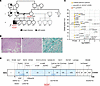
Nearly 100 individuals have been identified who carry deleterious biallelic germline variants in CARD9 and experience life-threatening, invasive fungal infections caused by Ascomycetes but are otherwise resistant to other infectious agents. CARD9 is an adaptor protein expressed predominantly in myeloid cells, which functions downstream of dectin receptors, pattern recognition receptors for fungal antigens, to activate innate immune responses. The impact of CARD9 deficiency on lymphocytes, however, is less clear. We deciphered the functional consequences and delineated mechanisms of disease in a patient (P1) with a nonsense germline homozygous CARD9 variant (c.673A>T/p.K225*) and invasive Candida disease. P1’s PBMCs expressed truncated CARD9 and showed significantly reduced cytokine production in response to fungal ligands. P1 had reduced frequencies of circulating memory CD4+ TH17-like (CCR6+CXCR3–) cells. In addition, in vitro differentiation of P1’s naive CD4+ T cells into IL-17A/IL-17F–secreting cells was greatly impaired. Consistent with impaired responses of innate and adaptive immune cells from P1 in vitro, proportions of Candida-specific CD4+ T cells were strongly and selectively diminished. Our findings suggest that the CARD9 variant identified in P1 is pathogenic, affecting not only CARD9-induced immunity mediated by myeloid cells but also CD4+ T cell–intrinsic IL-17–dependent immunity and Candida-specific T cell responses.
Authors
Erika Della Mina, Carlos G. El-Haddad, Timothy A. West, Clara W.T. Chung, Jing Jing Li, Vivienne Lea, Elissa K. Deenick, Filomeen Haerynck, Jean-Laurent Casanova, Anne Puel, Cindy S. Ma, Stuart G. Tangye, Alisa Kane
Abstract
Natural killer (NK) cells are pivotal in the early immune response to Plasmodium falciparum infection, yet their functional dynamics and regulation remain incompletely understood. In a longitudinal study of malaria patients in a non-endemic setting, we observed a transient but potent activation of NK cell cytotoxicity during acute malaria, characterized by rapid granzyme B-mediated killing and elevated expression of genes associated with cytotoxicity (PRF1, GZMB, and GZMA). This heightened activity was supported by increased plasma levels of granzymes and proinflammatory cytokines, which enhanced NK cell function in vitro. However, plasma samples from clinical malaria also contained inhibitory mediators, including soluble cytokine receptors, which dampened NK cell responses. These findings reveal that the host microenvironment orchestrates a tightly regulated NK cell response that potentiates cytotoxicity during acute infection and rapidly downmodulate it after treatment. Understanding this balance between activation and suppression may inform strategies to harness NK cells for malaria control while minimizing immunopathology.
Authors
Pengjun Xi, Patrick A. Sandoz, Maximilian Julius Lautenbach, Eleni Bilev, Björn Önfelt, Anna Färnert, Quirin Hammer, Christopher Sundling
Abstract
BACKGROUND. Disseminated coccidioidomycosis (DCM) is an often fatal and otherwise intractable condition requiring lifelong antifungal treatment. We have previously shown that a deranged polarization of CD4+ T cells toward a Th2 phenotype can exist in the context of DCM. Here we studied a large population of subjects to determine the frequency of abnormal Th2 skewing of CD4+ T cells in patients with coccidioidomycosis and to identify underlying genetic mechanisms supporting this phenotype. METHODS. We collected peripheral blood mononuclear cells from 204 patients with coccidioidomycosis, including 96 patients with disseminated disease. We measured immune phenotypes and cytokine production by CD4+ T cells from patients and healthy controls, and comparisons between groups were made based on disease severity and demographics. Whole genome sequencing was conducted on 180 individuals who also had cytokine profiling. RESULTS. We found that ~25% of DCM patients had a CD4+ T-cell compartment that was abnormally skewed toward a Th2 phenotype, and Th2 skewing was highly correlated with male sex. Co-culture of T cells with the IL4R/IL13R-blocking antibody dupilumab reduced Th2 skewing. Sequencing revealed rare variants in genes involved in the IL-12-IFN-γ axis in several Th2-skewed patients, and we validated one such variant in IFNGR1 as hypomorphic. CONCLUSION. Patients with DCM, especially males, should be screened for Th2 skewing of CD4+ T cells. Patients with Th2 skewing should be additionally screened for genetic defects in the IL-12-IFN-γ axis. Our findings give a mechanistic rationale for blockade of IL4R in Th2-skewed patients with refractory coccidioidomycosis.
Authors
Timothy J. Thauland, Smriti S. Nagarajan, Alexis V. Stephens, Samantha L. Jensen, Anviksha Srivastava, Miguel A. Moreno Lastre, Terrie S. Ahn, Chantana Bun, Michael T. Trump, Royce H. Johnson, George R. Thompson III, Maria I. Garcia-Lloret, Valerie A. Arboleda, Manish J. Butte
No posts were found with this tag.


