
Gastroenterology
Abstract
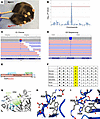
Glycans are one of the 4 major macromolecules essential for life and are the most abundant family of organic molecules. However, in contrast with DNA and RNA, glycan structures have no template; this results in limited tools to study this challenging macromolecule with a diversity of glycan structures. A central bottleneck in studying glycosylation in vivo is that inhibitors and complete KOs are lethal. In a forward genetic screen, we identified a viable, hypomorphic mutation at a conserved site in mannose phosphate isomerase (Mpi) that causes a multisystemic phenotype affecting RBCs, liver, stomach, intestines, skin, size, fat, and fluid balance in mice. The phenotype could be rescued with mannose. Analyses of glycopeptides in mice with this mutation showed a 500% increase in unoccupied N-glycan sites. This is equivalent to a “glycan knockdown,” which would be useful for examining the role of glycans in biology and disease. Therefore, we report an in vivo tool to study global N-glycosylation deficiency with tissue-specific targeting and a rescue mechanism with mannose.
Authors
Elisa B. Lin, Steve Meregini, Zhao Zhang, Avishek Roy, Tandav Argula, James M. Mitchell, William J. Israelsen, Sara Ludwig, Jamie Russell, Jiexia Quan, Sara Hildebrand, Evan Nair-Gill, Bruce Beutler, Jeffrey A. SoRelle

Abstract
Background Ready-to-use supplemental foods (RUSF) are energy-dense meals used to treat moderate and severe acute childhood malnutrition. Weight recovery with RUSF is heterogeneous, therefore we investigated whether environmental enteric dysfunction (EED), systemic inflammation, and gut microbiota predict RUSF response.Methods We followed nutritional status and RUSF outcomes in a rural birth cohort of 416 Pakistani infants. Acha Mum, a chickpea-based RUSF, was administered daily for 8 weeks to children who developed wasting (weight-for-length Z-score <–2).Results Of 187 treated with RUSF, 112 showed no immediate improvement in weight-for-age. Machine learning identified nine biomarkers that collectively predicted RUSF response with 73% accuracy. Gut microbiome composition before and after supplementation predicted response with 93% and 98% accuracy, respectively. Responders showed microbiome restructuring, with increased growth-associated taxa and reduced Gammaproteobacteria relative to nonresponders. A subset of extreme nonresponders—whose microbiome profiles resembled those of responders—displayed markedly abnormal biomarkers of inflammation, suggesting adverse host factors constrain gut microbiota benefits for RUSF efficacy.Conclusion EED, systemic inflammation, and gut microbiota predict acute nutritional responses to Acha Mum, setting the stage for precision use of RUSF and adjunctive therapies in addressing the global burden of childhood malnutrition in low- and middle-income countries.
Authors
Zehra Jamil, Gabriel F. Hanson, Junaid Iqbal, G. Brett Moreau, Najeeha Talat Iqbal, Sheraz Ahmed, Aneeta Hotwani, Furqan Kabir, Fayaz Umrani, Kamran Sadiq, Kumail Ahmed, Indika Mallawaarachchi, Jennie Z. Ma, Fatima Aziz, S. Asad Ali, Sean R. Moore

Abstract
Pancreatic stellate cells (PSCs) are the origin of cancer-associated fibroblasts. Type 2 diabetes mellitus (T2D) may promote pancreatic ductal adenocarcinoma (PDAC), eliciting changes in the quiescent PSC (qPSC) population from the precancerous stage. However, the details are unknown. We evaluated the subpopulations of qPSCs and the impact of T2D. PSCs isolated from 8-week-old C57BL/6J mice and diabetic db/db mice were analyzed by single-cell RNA-seq. Sorted qPSCs and PDAC cells were transplanted into allogenic mice. The isolated qPSCs were broadly classified into mesothelial cell and pancreatic fibroblast (Paf) populations by single-cell RNA-seq. Pafs were subclassified into inflammatory Pafs, myofibroblastic Pafs (myPafs) and a small population named tumor immunity- and angiogenesis-promoting Pafs (tapPafs), expressing Cxcl13. In the subcutaneous transplantation model, the tumors transplanted with myPafs were significantly larger than the tumors transplanted with tapPafs. An increase in myPafs and a decrease in tapPafs were observed from the precancerous stage in human T2D, indicating the effects of tumor progression. This study revealed the subpopulation changes in qPSCs in T2D. A therapy that increases the number of tapPafs could be a therapeutic option for patients with PDAC and T2D and even those in a precancerous stage of T2D.
Authors
Yutaro Hara, Hiroki Mizukami, Takahiro Yamada, Shuji Shimoyama, Keisuke Yamazaki, Takanori Sasaki, Zhenchao Wang, Hanae Kushibiki, Masaki Ryuzaki, Saori Ogasawara, Hiroaki Tamba, Akiko Itaya, Norihisa Kimura, Keinosuke Ishido, Shinya Ueno, Kenichi Hakamada
Abstract
The prognosis for colorectal cancer (CRC) patients with liver metastasis remains poor, and the molecular mechanisms driving CRC liver metastasis are still not fully understood. Hypoxia-induced extracellular vesicles (H-EVs) derived from tumors have emerged as key players in inducing angiogenesis by transferring non-coding RNAs. However, the specific role of CRC-derived hypoxic EVs (H-EVs) in regulating the formation of the pre-metastatic microenvironment (PMN) by inducing angiogenesis remains unclear. Our study demonstrates that H-EVs induce both angiogenesis and liver metastasis. Through microRNA microarray analysis, we identified a reduction in miR-6084 levels within H-EVs. We found that miR-6084 inhibits angiogenesis by being transferred to endothelial cells via EVs. In endothelial cells, miR-6084 directly targets ANGPTL4 mRNA, thereby suppressing angiogenesis through ANGPTL4-mediated JAK2/STAT3 pathway. Furthermore, we uncovered that SP1 acts as a transcription factor regulating miR-6084 transcription, while HIF1A decreases miR-6084 expression by promoting SP1 protein dephosphorylation and facilitating ubiquitin‒proteasome degradation in SW620 cells. In clinical samples, we observed low expression of miR-6084 in plasma-derived EVs from CRC patients with liver metastasis. In summary, our findings suggest that CRC-derived hypoxic EVs promote angiogenesis and liver metastasis through the HIF1A/SP1/miR-6084/ANGPTL4 axis. Additionally, miR-6084 holds promise as a potential diagnostic and prognostic biomarker for CRC liver metastasis.
Authors
Yang Zhang, Xuyang Yang, Su Zhang, Qing Huang, Sicheng Liu, Lei Qiu, Mingtian Wei, Xiangbing Deng, Wenjian Meng, Hai-Ning Chen, Yaguang Zhang, Junhong Han, Ziqiang Wang

Abstract
Heme iron (HI), derived principally from hemoglobin (Hb) in animal foods, is a highly bioavailable source of dietary iron for humans. Despite several decades of focused research, however, molecular mechanisms governing HI absorption remain undefined. Previous studies in mice and rats have not produced a consensus, definitive model of efficient HI absorption/utilization. We hypothesized that a nutritional approach, using semipurified, HI-containing diets, could be utilized to establish a tractable rodent model of HI absorption that could ultimately be employed to test the roles of receptors, transporters, and enzymes using genetic engineering technology. Experiments were designed to assess HI utilization by feeding animals AIN-93G–based, HI-enriched experimental diets formulated with lyophilized porcine RBCs, containing approximately 85% HI and 15% nonheme iron (NHI). Total iron was within the physiological range (50–75 ppm) and precisely matched NHI control diets containing ferrous sulfate were utilized as comparators. Notably, in Sprague-Dawley (S-D) rats and C57BL/6 (B6) mice, dietary HI effectively (a) resolved iron-deficiency anemia; (b) supported normal pregnancy, lactation, and neonatal development; and (c) contributed to iron loading in Hamp-KO mice and rats (modeling hereditary hemochromatosis). A nutritional paradigm has thus been established that facilitates investigation into mechanisms of HI absorption by S-D rats and B6 mice.
Authors
Jennifer K. Lee, Yue He, Shireen R.L. Flores, Regina R. Woloshun, Xiaoyu Wang, Jacob S. Shine, Pearl O. Ebea-Ugwuanyi, Sitara Sriram, Melissa Fraga, Sean Zhu, Yang Yu, Iqbal Hamza, James F. Collins
Abstract
Resistance to chemotherapy of pancreatic ductal adenocarcinoma (PDAC) is largely driven by intratumoral heterogeneity (ITH) due to tumor cell plasticity and clonal diversity. In order to develop novel strategies to overcome this defined mechanism of resistance, tools to monitor and quantify ITH in a rapid and scalable fashion are needed urgently. Here, we employed label-free digital holographic microscopy (DHM) to characterize ITH in PDAC. We established a robust experimental and machine learning analysis pipeline to perform single cell phenotyping based on DHM-derived phase images of PDAC cells in suspension. Importantly, we are able to detect dynamic changes in tumor cell differentiation and heterogeneity of distinct PDAC subtypes upon induction of epithelial-to-mesenchymal transition and under treatment-imposed pressure in murine and patient-derived model systems. This platform allows us to assess phenotypic ITH in PDAC on a single cell level in real-time. Implementing this technology into the clinical workflow has the potential to fundamentally increase our understanding of tumor heterogeneity during evolution and treatment response.
Authors
Katja Wittenzellner, Manuel Lengl, Stefan Röhrl, Carlo Maurer, Christian Klenk, Aristeidis Papargyriou, Laura Schmidleitner, Nicole Kabella, Akul Shastri, David E. Fresacher, Farid Harb, Nawal Hafez, Stefanie Bärthel, Daniele Lucarelli, Carmen Escorial-Iriarte, Felix Orben, Rupert Öllinger, Ellen Emken, Lisa Fricke, Joanna Madej, Patrick Wustrow, I. Ekin Demir, Helmut Friess, Tobias Lahmer, Roland M. Schmid, Roland Rad, Günter Schneider, Bernhard Kuster, Dieter Saur, Oliver Hayden, Klaus Diepold, Maximilian Reichert

Abstract
Oxytocin plays a key role in reproductive physiology but has recently garnered interest for its involvement in modulating feeding behavior. The vagus nerve contributes to feeding behavior control, as well as other gastrointestinal functions. Oxytocin receptors (OTR) are expressed on the vagus, but their role is poorly understood. Herein, we evaluated the contribution of the vagal OTR to food intake and body weight control in male and female rats. Virogenetic knockdown of vagal OTR resulted in reduced body weight and food intake in male rats. Loss of OTR in the vagus also resulted in suppressed locomotor activity in males but hyperactivity in females. Importantly, rats with vagal OTR knockdown, but not controls, exhibited a significantly elevated mortality rate starting 4 weeks after knockdown, with males being disproportionately affected. Mortality followed large eating bouts and was accompanied by abnormal presence of food in the mouth and esophagus, suggesting death by aspiration or food in the airways and suggesting a crucial role of vagal OTR in upper gastrointestinal tract motility. Furthermore, in vivo experiments revealed impaired esophageal transit. Ex vivo findings indicated oxytocin’s contribution to lower esophageal sphincter contraction. Our findings demonstrated a critical role for the oxytocin system: essential function of vagal OTR for esophageal transit and swallowing.
Authors
Mohammed Asker, Jean-Philippe Krieger, Ivana Maric, Emre Bedel, Jenny Steen, Stina Börchers, Yuxiang Wen, Francesco Longo, Patrik Aronsson, Michael Winder, Robert P. Doyle, Matthew R. Hayes, Karolina P. Skibicka

Abstract
Metabolic dysfunction–associated steatotic liver disease (MASLD) is the most common chronic liver disease worldwide for which there is only one approved treatment. Adenosine monophosphate–activated protein kinase (AMPK) is an interesting therapeutic target since it acts as a central regulator of cellular metabolism. Despite efforts to target AMPK, no direct activators have yet been approved for treatment of this disease. This study investigated the effect of the AMPK activator ATX-304 in a preclinical mouse model of progressive fatty liver disease. The data demonstrated that ATX-304 diminishes body fat mass, lowers blood cholesterol levels, and mitigates general liver steatosis and the development of liver fibrosis, but with pronounced local heterogeneities. The beneficial effects of ATX-304 treatment were accompanied by a shift in the liver metabolic program, including increased fatty acid oxidation, reduced lipid synthesis, as well as remodeling of cholesterol and lipid transport. We also observed variations in lipid distribution among liver lobes in response to ATX-304, and a shift in the zonal distribution of lipid droplets upon treatment. Taken together, our data suggested that ATX-304 holds promise as a potential treatment for MASLD.
Authors
Emanuel Holm, Isabeau Vermeulen, Saba Parween, Ana López-Pérez, Berta Cillero-Pastor, Michiel Vandenbosch, Silvia Remeseiro, Andreas Hörnblad
Abstract
Authors
Máté Sándor, Balázs Csaba Németh, Alexandra Demcsák, Miklós Sahin-Tóth

Abstract
Infectious complications (ICs) in acute pancreatitis (AP) are primarily driven by intestinal bacterial translocation, significantly increasing mortality and hospital stays. Despite this, the role of the gut microenvironment, particularly its metabolic aspects, in AP remains poorly understood. In this study, we investigated a cohort of patients with AP, and conducted supplemental murine studies, to explore the relationship between the gut metabolome and the development of ICs. Metabolomic analysis revealed that disruptions in gut tryptophan metabolism — especially reductions in serotonin and indole pathways — are key features associated with IC occurrence. Additionally, elevated plasma levels of tryptophan metabolites within the kynurenine pathway were identified as valuable predictive biomarkers for ICs. Mechanistic studies in murine models demonstrated that an impaired intestinal Th17 response, modulated by these tryptophan metabolites, plays a critical role in IC development. Serotonin supplementation enhanced Th17 responses, reducing IC incidence, while administration of kynurenic acid, a kynurenine metabolite, exacerbated pancreatic infections, potentially through immunosuppressive effects. These findings highlight the pivotal role of tryptophan metabolites in AP pathogenesis, emphasizing their potential as both predictive markers and therapeutic targets in IC management.
Authors
Daosheng Wang, Silei Sun, Qianli Zhao, Bing Zhao, Li Ma, Tongxuan Su, Lili Xu, Menglu Gui, Dan Xu, Wei Chen, Yu Zeng, Yining Shen, Yiyue Liu, Cen Jiang, Qi Ni, Yingchao Cui, Yide Lu, Qiuya Lu, Danfeng Dong, Yibing Peng, Enqiang Mao
No posts were found with this tag.


