
Autoimmunity
Abstract
Acute rheumatic fever (ARF) and associated rheumatic heart disease are serious sequelae of a Group A Streptococcus (GAS/Strep A) infection. Autoantibodies are thought to contribute to pathogenesis, with deeper exploration of the autoantibody repertoire needed to improve mechanistic understanding and identify new biomarkers. Phage immunoprecipitation and Sequencing (PhIP-Seq) with the HuScan library (>250,000 overlapping 90-mer peptides spanning the human proteome) was utilised to analyse autoreactivity in sera from children with ARF, uncomplicated Strep A pharyngitis and matched healthy controls. A global proteome-wide increase in autoantigen reactivity was observed in ARF, as was marked heterogeneity between patients. Public epitopes, common between individuals with ARF were rare, and comprised < 1% of all enriched peptides. Differential analysis identified both novel and previously identified ARF autoantigens, including PPP1R12B, a myosin phosphatase complex regulatory subunit expressed in cardiac muscle, and members of the collagen-protein family, respectively. Pathway analysis found antigens from the disease-relevant processes encompassing sarcomere and heart-morphogenesis were targeted. In sum, PhIP-Seq has substantially expanded the spectrum of autoantigens in ARF, and reveals the rarity of public epitopes in the disease. It provides further support for the role of epitope spreading in pathogenesis and has identified PPP1R12B as a novel, enriched autoantigen.
Authors
Reuben McGregor, Lauren H. Carlton, Timothy J. O'Donnell, Elliot Merritt, Campbell R. Sheen, Florina Chan Mow, William John Martin, Michael G. Baker, Nigel Wilson, Uri Laserson, Nicole J. Moreland
Abstract
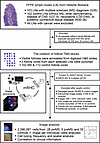
The efficacy of anti-CD20 therapies places B cells and their interaction with T cells at the center of attention for multiple sclerosis (MS) pathogenesis. Follicular T helper cells (Tfh), which guide B cell maturation in germinal centers within lymph nodes (LNs), are elevated in the circulation and cerebrospinal fluid of patients with MS (pwMS). However, the LN spatial landscape has remained largely without investigation for pwMS. Using cyclic immunofluorescence, we assessed cell abundance and spatial connections in FFPE LNs of 33 pwMS and 35 non-MS controls. The presence of EBV was analyzed through EBER immunostaining and multiplex quantitative PCR. Our analysis showed that Tfh cells were expanded in LNs of pwMS and accumulated especially in the mantle zone and B cell follicles compared with controls. The Tfh/T follicular regulator ratio was increased in pwMS, while B cell ratios were similar between the cohorts. The interaction of Tfh cells with follicular B cells was higher in pwMS. Interestingly, Tfh accumulation was also observed in 5 prediagnostic MS cases. No signs of EBV latency were detected in either group. These findings highlight LNs as a site of early and persistent immune activation in pwMS, with therapeutic implications to be further addressed.
Authors
Joona Sarkkinen, Eliisa Kekäläinen, Leo Hannolainen, Ada Junquera, Johannes Dunkel, Maria F. Perdomo, Mikko I. Mäyränpää, Sini M. Laakso
Abstract
In the rheumatoid arthritis (RA) synovium, resident fibroblast-like synoviocytes (FLS) express MHC class II molecules (HLA-D) but lack the co-stimulatory signals typically required for T cell activation. Here, we demonstrate that antigen presentation by FLS induces a distinct T cell activation state characterized by high CD69, yet reduced CD25 and HLA-DR expression, suppressed proliferation, and decreased effector cytokine production compared to professional antigen presenting cells (APCs), such as macrophages. FLS were also capable of suppressing macrophage-induced T cell activation, underscoring their dominant immunomodulatory role in the synovial microenvironment. Mechanistically, we identify indoleamine 2,3-dioxygenase (IDO1)-mediated tryptophan depletion as the primary driver of FLS-induced T cell hypo-responsiveness. Spatial transcriptomics revealed colocalization of IDO1 and CD69 within ectopic lymphoid structures in RA synovium, further supporting the in vivo relevance of this pathway. These findings provide the groundwork for positioning FLS as critical T cell regulators in RA and highlight the importance of preserving their immunosuppressive properties when therapeutically targeting pathogenic FLS functions.
Authors
Melissa R. Romoff, Preethi K. Periyakoil, Edward F. DiCarlo, Daniel Ramirez, Susan M. Goodman, Christina S. Leslie, Alexander Y. Rudensky, Laura T. Donlin, Melanie H. Smith
Abstract
Rheumatoid arthritis (RA) is a common systemic autoimmune disorder. Fibroblast-like synoviocytes (FLS) have emerged as an attractive target for non-immunosuppressive RA therapy, but there are no approved drugs targeting FLS. The receptor protein tyrosine phosphatase sigma (PTPRS) negatively regulates FLS migration and has been proposed as a target for FLS-directed RA therapy. Here we examined the impact of sequence variations on efficacy of an FLS-targeted biologic comprised of Fc-fused PTPRS immunoglobulin (IgG)-like domains Ig1 and Ig2 (Ig1&2-Fc). Engineering the linker and Fc tag improved effectiveness of human Ig1&2-Fc in assays of FLS migration and a mouse model of arthritis. Treatment of mice with Ig1&2-Fc over four months revealed no signs of toxicity or organ pathology. Finally, we show potential of Ig1&2-Fc co-administration in combination or as a bispecific fusion with a tumor necrosis factor alpha inhibitor (TNFi). Combination treatment of mouse tumor necrosis factor receptor 2 (mTnfr2) with Ig1&2-Fc resulted in increased efficacy in suppressing arthritis beyond single agent treatment. When administered as a dual-action bispecific, Ig1&2 fused to mTnfr2 proved more efficacious at suppressing arthritis than mTnfr2 alone. This study illustrates the potential of Ig1&2-Fc as a combination or bispecific therapy with DMARDs to improve patient outcomes in RA.
Authors
Sterling H. Ramsey, Zixuan Zhao, Megan C. Lee, Thales Hein da Rosa, Ava C. Schneider, Miriam Bollmann, Nour Dada, Katie Frizzi, May M. Han, Jaeyeon Kim, Martina Zoccheddu, Nigel A. Calcutt, Gary S. Firestein, James W. Bryson, Mattias N.D. Svensson, Eugenio Santelli, Stephanie M. Stanford, Nunzio Bottini
Abstract
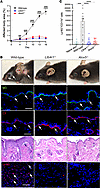
Mucous membrane pemphigoid (MMP) is a mucocutaneous autoimmune blistering disease affecting diverse mucous membranes and the skin with inflammatory blisters and erosions. The pathogenesis of MMP is only poorly understood, but inflammation in MMP is triggered by specific binding of autoantibodies directed to different proteins of the dermal-epidermal/-epithelial junction, subsequently leading to the influx of inflammatory cells, particularly neutrophils, into the dermis. Using the anti-laminin 332 antibody transfer model of MMP, we addressed the molecular mechanisms of neutrophil infiltration and its significance for the eruption of mucocutaneous lesions. Mice deficient in 5-lipoxygenase (Alox5–/–) or in the leukotriene B4 (LTB4) receptor BLT1 (Ltb4r1–/–) were resistant to skin inflammation and exhibited substantially fewer mucosal lesions, with deficiency in either gene compromising the recruitment of neutrophils to the lesion. Furthermore, neutrophil-specific genetic deficiency in Ltb4r1 similarly protected from MMP. Hence, BLT1 was required on neutrophils, and neutrophil recruitment was indispensable for the eruption of lesions in MMP. In line with these findings, the BLT1 inhibitor CP-105,606 ameliorated MMP dose-dependently. Collectively, our results highlight neutrophils and LTB4/BLT1 as key drivers of inflammation in MMP and as promising therapeutic targets.
Authors
Tabea Bremer, Sripriya Murthy, Sabrina Patzelt, Paul Schilf, Mareike Neumann, Sina Gonther, Jasper Pruessmann, Wiebke Pruessmann, Enno Schmidt, Thomas Rülicke, Christian D. Sadik
Abstract
Glutaminolysis is enhanced in T cells of lupus patients and in follicular helper T (Tfh) cells, a critical subset of CD4+ T cells that provide help to autoreactive B cells, in lupus mice. Glutaminolysis inhibitors reduced lupus activity in association with a decreased frequency of Th17 cells in mice. Here, we thought to determine the role of glutaminolysis in murine Tfh cells. The pharmacological inhibition of glutaminolysis with DON reduced the expression of the critical costimulatory molecule ICOS on lupus Tfh cells, in association with a reduction of autoantibody production and B cell differentiation markers. Accordingly, profound transcriptomic and metabolic changes, including a reduction of glycolysis, were induced by DON in lupus Tfh cells, whereas healthy Tfh cells showed minor changes. The T cell-specific genetic inhibition of glutaminolysis largely phenocopied the effects of DON on Tfh cells and B cells in an autoimmune genetic background with minor changes in Tfh and B cells in healthy controls. Furthermore, we showed that T cell-specific glutaminolysis inhibition impaired T-dependent humoral responses in autoimmune mice as well as their Tfh response to a viral infection. Overall, these results suggest that lupus Tfh cells have a greater intrinsic requirement of glutaminolysis for their helper functions.
Authors
Seung-Chul Choi, Yong Ge, Milind V. Joshi, Damian Jimenez, Abigail Castellanos Garcia, Cassandra LaPlante, Lauren T. Padilla, Chaoyu Ma, Nu Zhang, Jeffrey C. Rathmell, Mansour Mohamadzadeh, Laurence Morel
Abstract
In celiac disease (CeD), a gluten-dependent autoimmune disorder, transglutaminase 2 (TG2) deamidates selected glutamine residues in gluten peptides, while HLA-DQ2 presents deamidated antigens to inflammatory T cells. The cellular sources of pathogenic TG2 and DQ2 are unclear. Using chemical biology tools, we show that intestinal CD103+ dendritic cells (DCs) couple cell-surface TG2 to the endocytic LRP1 receptor to simultaneously deamidate gluten antigens and concentrate them in lysosomes. In DQ2-transgenic mice, CD103+ DCs loaded with deamidated antigens migrate from intestinal lamina propria and Peyer’s patches into mesenteric lymph nodes, where they engage T cells. In turn, gluten antigen presentation upregulates intestinal TG2 activity. The tool (HB-230) used to establish a role of CD103+ DCs in gluten antigen presentation and TG2 activation in mice also revealed that the TG2/LRP1 pathway is active in human CD14+ monocytes. Within this population of circulating monocytes, a DC subset with the gut-homing β7-integrin marker is elevated in CeD patients with active disease compared to non-celiac controls or patients on a gluten-free diet. Our findings not only inform the cellular basis for gluten toxicity in CeD but they also highlight the immunologic role of an enigmatic protein of growing therapeutic relevance in CeD and other immune disorders.
Authors
Fu-Chen Yang, Harrison A. Besser, Hye Rin Chun, Megan Albertelli, Nielsen Q. Fernandez-Becker, Bana Jabri, Chaitan Khosla
Abstract
FOXP3+ Treg cells are critical for immune tolerance. Genetic deletion of the Forkhead domain containing proteins of the FOXP-subfamily member FOXP1 from Tregs results in impaired function associated with reduced CD25 expression and IL-2 signaling, but to date the only other FOXP family member expressed in Tregs, FOXP4, has been minimally studied. To investigate the potential functional interactions among FOXP family members in Treg cells, we specifically deleted Foxp1, Foxp4 or both in FOXP3+ committed Treg cells in mice. Our findings show that mice with combined, but not individual, deficiency in FOXP1 and FOXP4 exhibit lymphoproliferation, inflammation, autoimmunity, and early lethality. The combined absence of FOXP1 and FOXP4 in Tregs results in an activated/effector-like phenotype with compromised suppressive function in peripheral lymphoid organs, an enhanced germinal center response and proinflammatory cytokine production. We further show that FOXP1 and FOXP4 bind to Il2ra promoter regions to regulate CD25 expression in Tregs. Through pairwise comparison among mouse strains with Treg specific deletion of Foxp1, Foxp4 or both, our findings indicate a non-redundant but insufficient role of FOXP4 in Treg cell function.
Authors
Dachuan Dong, Vishal J. Sindhava, Ananthakrishnan Ganesan, Martin S. Naradikian, Tom L. Stephen, Andrew Frisch, Kristen M. Valentine, Elizabeth Buza, Karla R. Wiehagen, Michael P. Cancro, Edward E. Morrisey, Haley Tucker, Katrina K. Hoyer, Purvesh Khatri, Jonathan S. Maltzman
Abstract
Regulatory T cells (Tregs) are essential for peripheral tolerance and depend on TCR and IL-2R signaling for their homeostasis and function. In mice, IL-2-dependent BLIMP-1 contributes to Treg homeostasis. BLIMP-1 is a major transcriptional hub in human Tregs, but its mechanisms of action remain undefined. Here, using CRISPR/Cas9 ablation, we show that BLIMP-1 limits human Treg proliferation, but supports IL-10, CTLA4, several immune checkpoints, including CEACAM1, and Treg functional activity. BLIMP-1 restrains Treg expansion to IL-2 by downregulating CD25 and IL-2R signaling, and by enhancing CEACAM1 expression, which in turn inhibits responsiveness to CD3/CD28 signaling and activation of mTOR. Prolonged IL-2R signaling optimizes BLIMP-1 expression, supporting chromosomal opening of CEACAM1 to increased CEACAM1 expression through STAT5- and BLIMP-1-driven enhancers. Correspondingly, CEACAM1 is highly induced on Tregs from autoimmune patients undergoing low-dose IL-2 therapy, and these Tregs showed reduced proliferation. A humanized mouse model of xenogeneic graft versus host disease demonstrates that BLIMP-1 normally promotes, while CEACAM1 restrains, Treg suppressive activity. Collectively, our findings reveal that BLIMP-1 and CEACAM1 function in an IL-2-dependent feedback loop to restrain Treg proliferation and affect suppressive function. CEACAM1 also acts as a highly selective biomarker of IL-2R signaling in human T cells.
Authors
Ying Ding, Aixin Yu, Milos Vujanac, Sabrina N. Copsel, Alejandro Moro, Luis Nivelo, Molly Dalzell, Nicolas Tchitchek, Michelle Rosenzwajg, Alejandro V. Villarino, Robert B. Levy, David Klatzmann, Thomas R. Malek
Abstract
Spondyloarthritis (SpA) is an inflammatory arthritis of the spine and joints associated with intestinal inflammation, in which it is hypothesized that innate immune exposure to entero-invasive species is followed by self/bacterial peptide presentation. However, the mechanisms underlying loss of tolerance to gut bacteria in genetically at-risk individuals are unclear. Curdlan (β-1,3-glucan, dectin-1 ligand)-treated ZAP-70W163C (SKG) mice develop autoimmune arthritis and ileitis associated with Gram-negative faecal dysbiosis. Using gnotobiotic mice, we show that curdlan-treated SKG mice mono-associated with Parabacteroides goldsteinii or Lactobacillus murinus developed ileitis, arthritis and enthesitis, while BALB/c mice were tolerant. Gnotobiotic SKG ileum upregulated Il23a and ER stress genes and lost goblet cells. Whereas bacterial DNA co-localised with neutrophils and inflammatory macrophages in SKG lamina propria, peri-articular bone marrow, entheses and spleen, in BALB/c bacterial DNA co-localised with resident macrophages in lamina propria and spleen. Human psoriatic-arthritis synovial tissue also contained cell-associated peri-vascular bacterial DNA. Curdlan-treated SKG spleen/bone marrow macrophages transferred severe arthritis and expanded Th17 cells in naïve SKG recipients, while BALB/c or germ free-SKG macrophages transferred mild arthritis and regulated Th17 cells. Thus, bacterial DNA and myeloid cells in the gut and their subsequent traffic regulate or enforce T cell pathogenicity in SpA.
Authors
Benjamin Cai, Rabina Giri, Amy J. Cameron, M. Arifur Rahman, Annabelle Small, Christopher Altmann, Yenkai Lim, Linda M. Rehaume, Mark Morrison, Mihir D. Wechalekar, Jakob Begun, Anne-Sophie Bergot, Ranjeny Thomas
No posts were found with this tag.


