
Submit a comment
Abstract
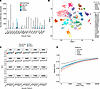
Selecting appropriate preclinical models is fundamental for translational oncology, yet a large-scale, multi-omic quantitative comparison of their similarity to primary human tumors is lacking. To address this, we integrated transcriptomic, proteomic, and genomic profiles from over 10,000 primary tumors from The Cancer Genome Atlas (TCGA) and the Clinical Proteomic Tumor Analysis Consortium (CPTAC), alongside 4,000 preclinical models. Using a robust computational framework, we revealed a clear hierarchy of transcriptomic and proteomic similarity to patient tumors: with patient-dervied xenografts (PDXs) having greater transcriptomic and proteomic similarity to patient tumors (>) compared with patient-derived organoids (PDOs), which are equal in hierarchy to that of PDX-dervied organoids (PDXOs) > cell lines. We also quantified high molecular conservation (Pearson correlation coefficient = 0.96) across paired in vitro to in vivo platform (organoids to PDX) transitions. Furthermore, genomic analysis demonstrated that whole-exome sequencing (WES) outperforms RNA-seq in detecting DNA variants, and it identified a clonal complexity hierarchy (cell lines > PDXOs > PDXs > PDOs) reflecting the effect of passaging history on intratumor heterogeneity. Ultimately, this study delivers a comprehensive quantitative benchmark, establishing a population-level hierarchy of molecular similarity between preclinical models and primary tumors and providing a data-driven reference for model selection. These findings offer a data-driven framework for selecting models that balance biological representativeness with experimental practicality.
Authors
Zixuan Xie, Jia Xue, Binchen Mao, Hengyuan Liu, Wubin Qian, Jingjing Wang, Xiaobo Chen, Sheng Guo
Guidelines
The Editorial Board will only consider comments that are deemed relevant and of interest to readers. The Journal will not post data that have not been subjected to peer review; or a comment that is essentially a reiteration of another comment.
- Comments appear on the Journal’s website and are linked from the original article’s web page.
- Authors are notified by email if their comments are posted.
- The Journal reserves the right to edit comments for length and clarity.
- No appeals will be considered.
- Comments are not indexed in PubMed.
Specific requirements
- Maximum length, 400 words
- Entered as plain text or HTML
- Author’s name and email address, to be posted with the comment
- Declaration of all potential conflicts of interest (even if these are not ultimately posted); see the Journal’s conflict-of-interest policy
- Comments may not include figures


