
Abstract
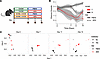
Malnutrition, gut inflammation, and antibiotic-induced dysbiosis are well-recognized risk factors for poor clinical outcomes among critically ill patients. We previously showed that commercially available plant-based enteral nutrition (PBEN) preserves a commensal microbiome compared with commonly used artificial enteral nutrition (AEN). In this study, PBEN was superior to AEN in promoting recovery from antibiotic-induced dysbiosis in mice and humans. PBEN effectively mitigated anemia and leukopenia, restored naive lymphocyte populations, and reduced bone marrow myeloid expansion. Animals randomized to PBEN also exhibited improved responses to infectious gastrointestinal challenges following antibiotic exposure. A pilot clinical study validated these findings, demonstrating increased gut commensals, reduced pathogens, and improved leukocyte balance in critically ill children receiving PBEN compared with AEN. Together, these results suggest that PBEN offers a practical dietary approach to mitigate antibiotic-associated complications and potentially improve clinical outcomes among hospitalized patients requiring supplemental nutrition.
Authors
Mona Chatrizeh, Jianmin Tian, Matthew Rogers, Firuz Feturi, Guojun Wu, Brian Firek, Roman Nikonov, Lauren Cass, Alexandra Sheppeck, Lavnish Ojha, Ali Carroll, Matthew Henkel, Justin Azar, Rajesh K. Aneja, Brian Campfield, Dennis Simon, Michael J. Morowitz
This file is in Adobe Acrobat (PDF) format. If you have not installed and configured the Adobe Acrobat Reader on your system.
Having trouble reading a PDF?
PDFs are designed to be printed out and read, but if you prefer to read them online, you may find it easier if you increase the view size to 125%.
Having trouble saving a PDF?
Many versions of the free Acrobat Reader do not allow Save. You must instead save the PDF from the JCI Online page you downloaded it from. PC users: Right-click on the Download link and choose the option that says something like "Save Link As...". Mac users should hold the mouse button down on the link to get these same options.
Having trouble printing a PDF?
- Try printing one page at a time or to a newer printer.
- Try saving the file to disk before printing rather than opening it "on the fly." This requires that you configure your browser to "Save" rather than "Launch Application" for the file type "application/pdf", and can usually be done in the "Helper Applications" options.
- Make sure you are using the latest version of Adobe's Acrobat Reader.


